
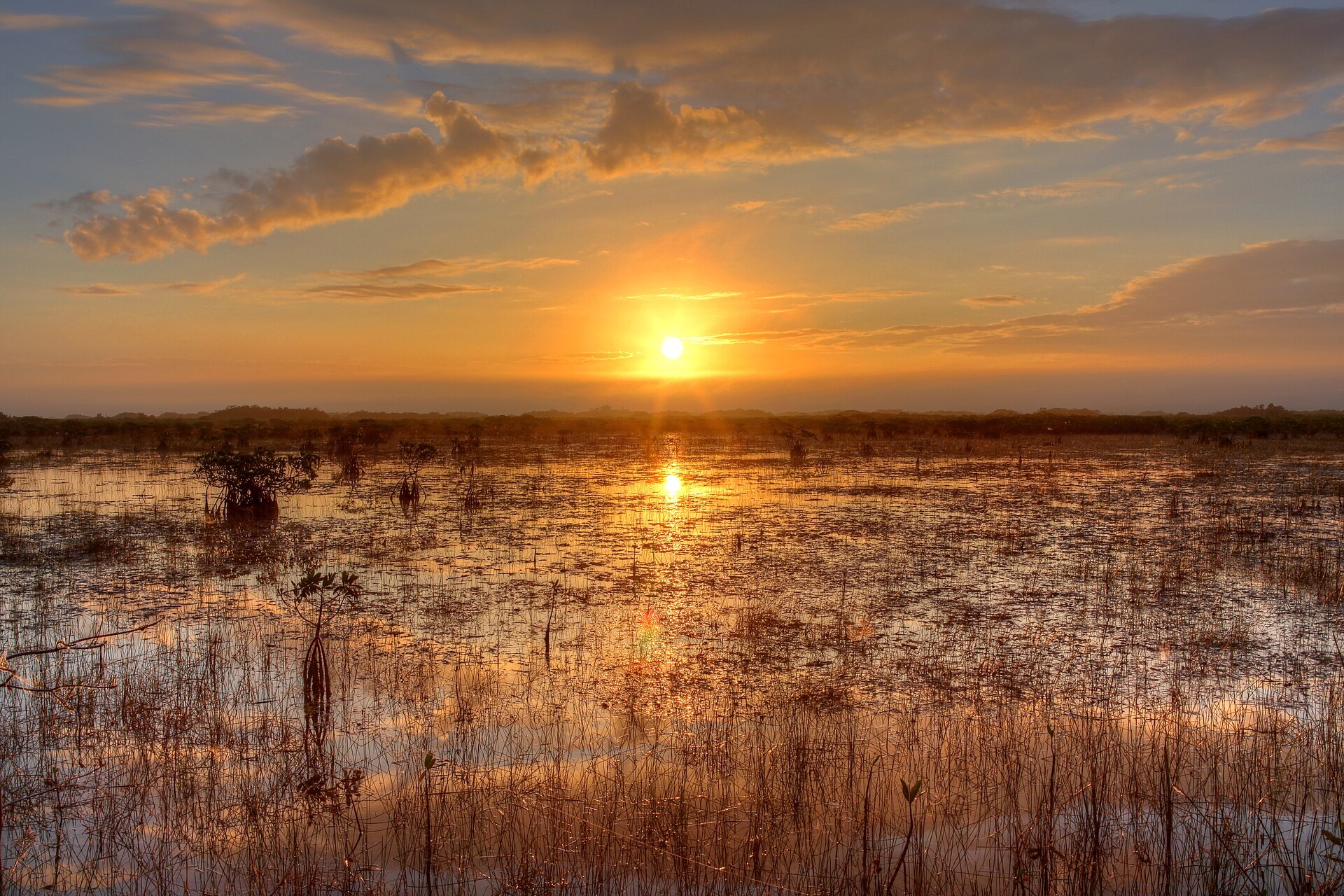
The fastest way to see Everglades National Park from Miami is to drive to one of two entrances: Shark Valley on Tamiami Trail (about an hour west of downtown) for a half day, or the main Homestead entrance (about an hour south) for a full day down to Flamingo. There is no bus or train into the park, so you need a car or a tour pickup. Go early, go in the dry season if you can, and plan on $35 per vehicle at the gate.
Quick steps: Visit the Everglades from Miami
- Pick one entrance for the day; Shark Valley and Homestead are 80 minutes apart.
- Check hours, fees and closures on the park’s official NPS page the night before.
- Fill the tank and buy water and snacks in Homestead or along SW 8th Street.
- Arrive before 9 a.m. in winter; Shark Valley’s lot fills by mid-morning.
- Pay at the gate (card accepted) or show an annual pass.
- Walk the Anhinga Trail first, then drive the 38 miles to Flamingo.
- Leave Flamingo by late afternoon; the drive back to Miami runs two hours.
What you need
- Car with a full tank (no fuel stations inside the park)
- Credit card or America the Beautiful pass
- 2 litres of water per person, more in summer
- Insect repellent with DEET or picaridin
- Sun hat, sunscreen, light long sleeves
- Binoculars and a downloaded offline map
- Closed shoes for boardwalks and the Flamingo marina
Choose your entrance before you leave Miami
The park covers roughly 1.5 million acres across Miami-Dade, Monroe and Collier counties, and its three visitor entrances do not connect inside the park. You cannot drive from Shark Valley down to Flamingo without going back out to public roads. Decide which experience you want first, then route to that gate.
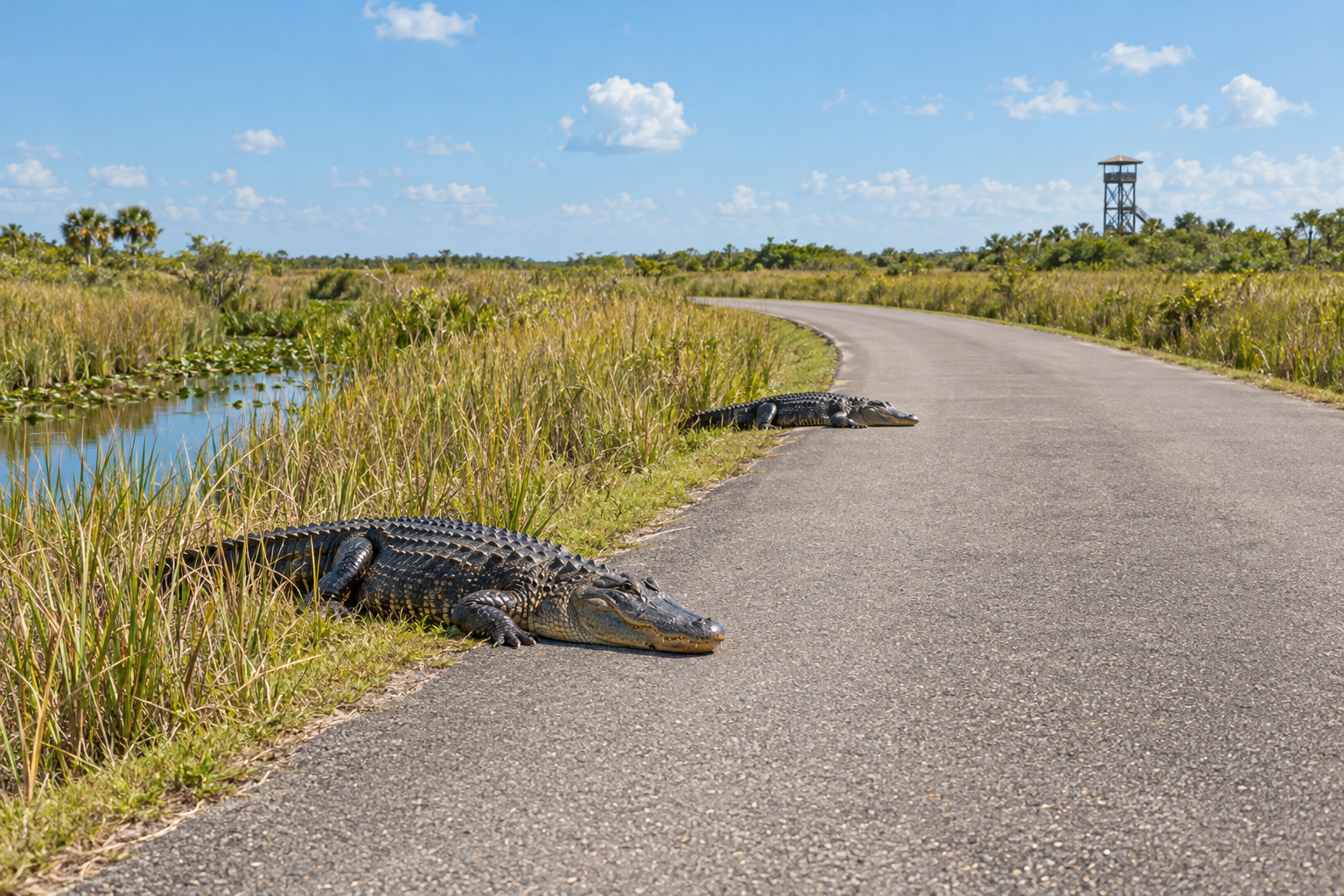
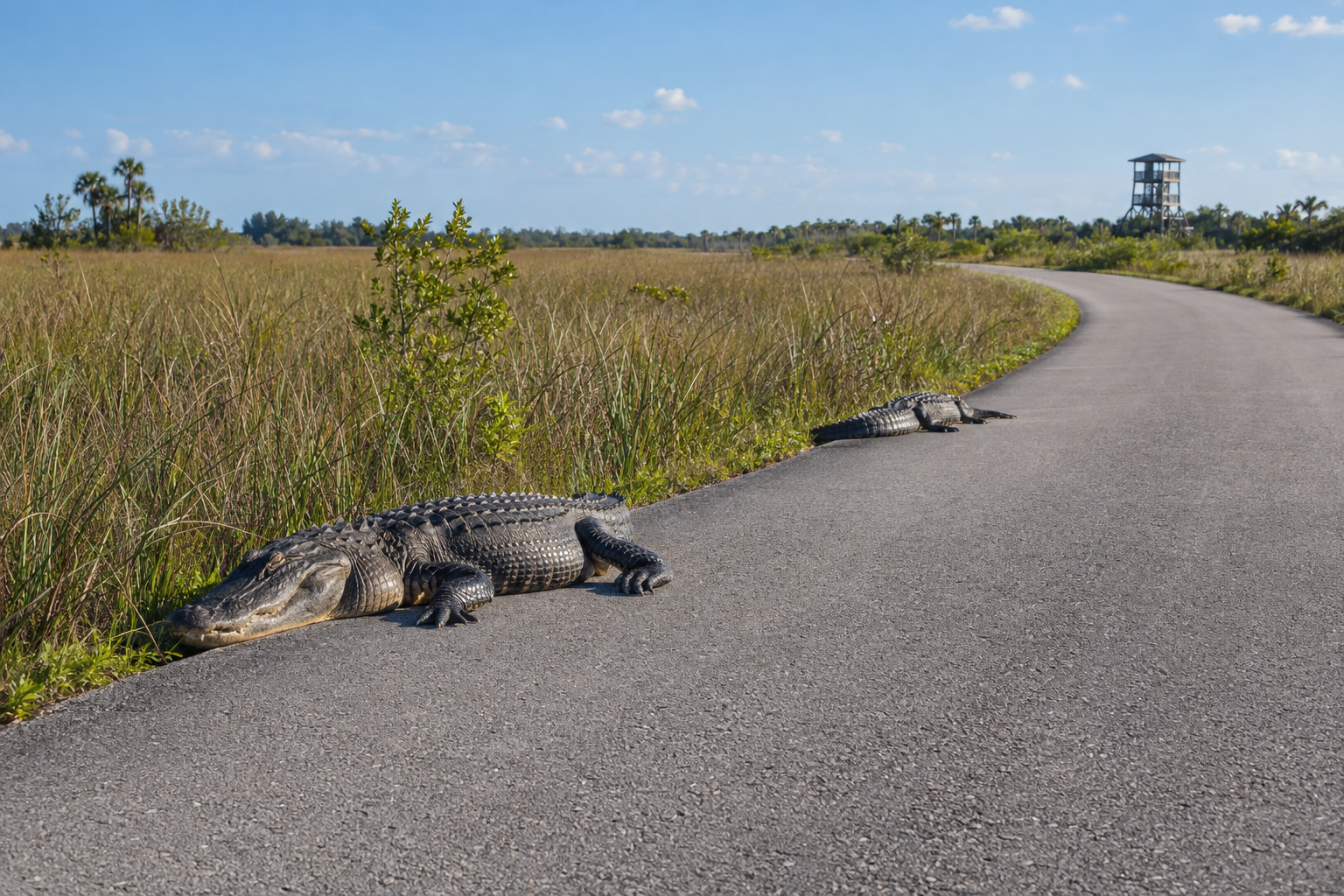
Shark Valley sits at 36000 SW 8th Street, on US 41 (Tamiami Trail) about 25 miles west of the Florida Turnpike. It is a single 15-mile paved loop through sawgrass with an observation tower at the far end. You do it by tram, by bike or on foot. Alligators sit on the asphalt edges in winter, close enough that rangers remind you to give them 15 feet. This is the entrance for anyone with a half day, kids, or no interest in long drives.
The main entrance near Homestead is at 40001 State Road 9336, just past Florida City. The Ernest F. Coe Visitor Center is at the gate, and from there the park road runs 38 miles to Flamingo on Florida Bay. Royal Palm, home of the Anhinga Trail, is only four miles in. This is the entrance for a full day, for boat tours, kayaking, camping and crocodiles.
The Gulf Coast entrance at Everglades City (815 Oyster Bar Lane) opens onto the Ten Thousand Islands, a mangrove maze best seen by boat. It is around 80 miles from Miami via Tamiami Trail, so budget close to two hours each way. Pair it with Big Cypress National Preserve if you go that far.
If you only have one day and one shot, take the Homestead entrance. Royal Palm alone delivers more wildlife per step than anywhere else in the park, and Flamingo adds manatees and crocodiles at the end of the road.
Getting there from Miami
Driving to the Homestead entrance
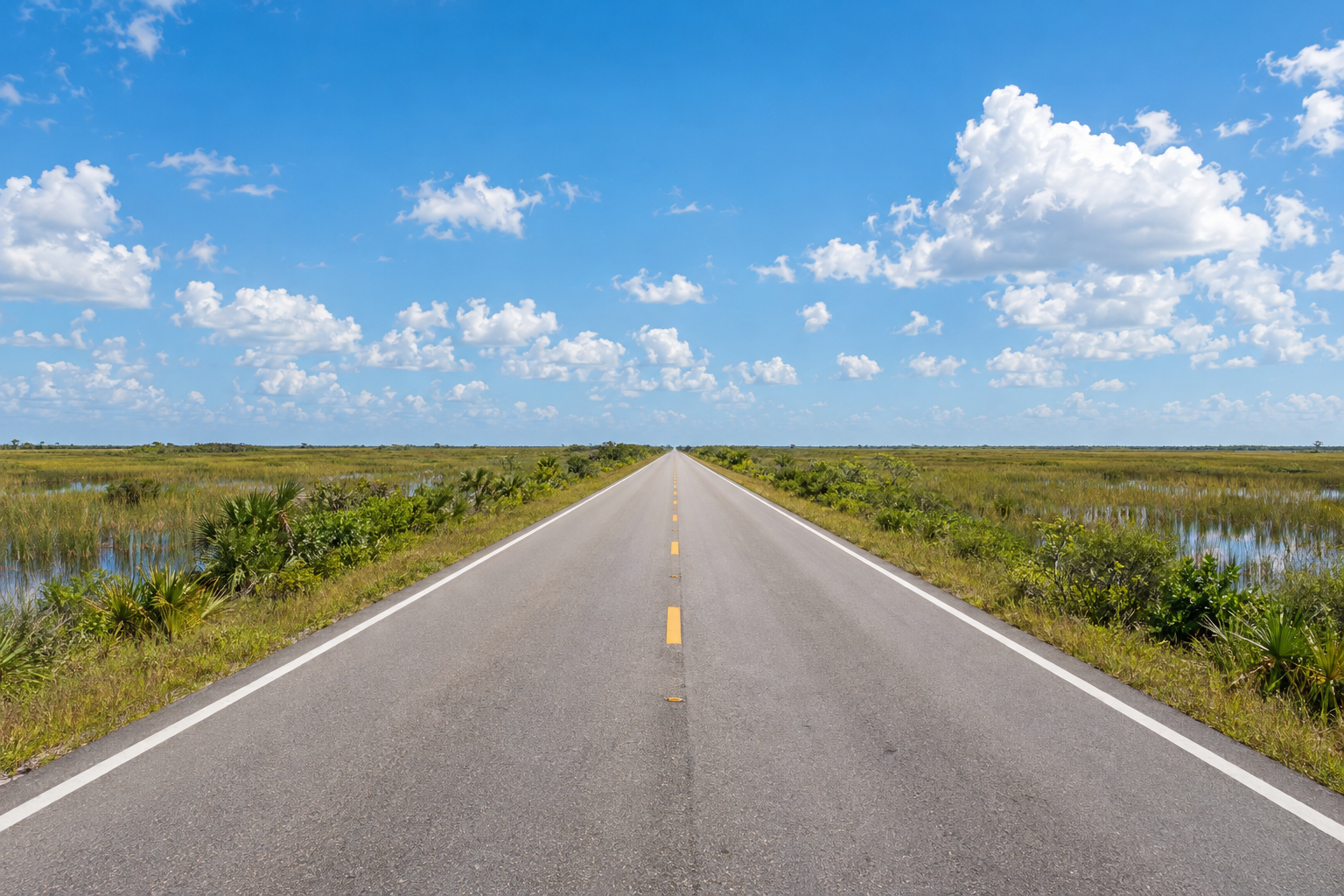
From downtown, Brickell or Miami Beach, take I-95 south to Florida’s Turnpike (SR 821, the Homestead Extension). Stay on the Turnpike to its end at US 1 in Florida City, then follow the brown National Park signs west on SW 344th Street (Palm Drive). Turn south onto SW 192nd Avenue, then west onto SR 9336, and the Coe Visitor Center appears after about ten miles of farmland. Count on 55 to 70 minutes without traffic, longer on weekday mornings.
The Turnpike is cashless. If you are in a rental from “miami international airport“, the car’s transponder or plate-pay program will bill tolls, so you do not need to stop. Expect roughly $5 to $8 in tolls each way depending on where you join.
From Fort Lauderdale or West Palm Beach, the Turnpike all the way south is the cleanest route; from Fort Lauderdale it is about 90 minutes, from West Palm about two and a half hours.
Driving to Shark Valley
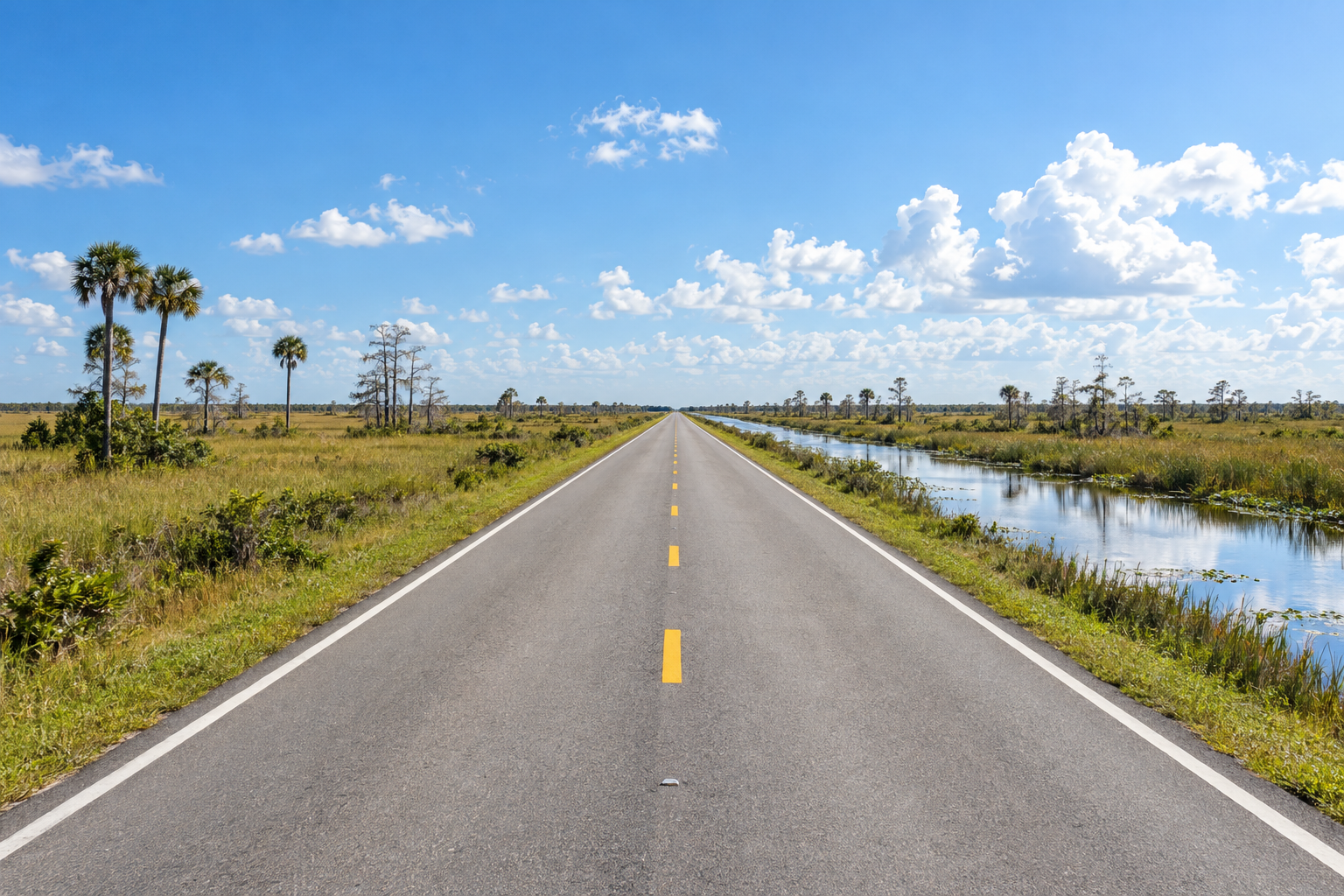
Take SR 836 (Dolphin Expressway) west to the Turnpike, exit at SW 8th Street (US 41), and head west. The road leaves the suburbs after Krome Avenue and runs straight through sawgrass for 18 miles. The Shark Valley entrance is on the south side; slow down, because the turn comes up quickly and cars often queue on the shoulder in winter. Allow 45 to 60 minutes from downtown.
Public transport and tours
No Miami-Dade Transit route serves the park. Route 38 (the Busway MAX) reaches Florida City, but that still leaves you about 12 miles from the Coe Visitor Center with no connecting service. The City of Homestead has run a free National Parks Trolley on winter weekends from downtown Homestead to Royal Palm and to Biscayne National Park, but the schedule changes year to year, so confirm it with the City of Homestead before relying on it.
Day tours from Miami Beach and downtown hotels mostly go to the airboat concessions on Tamiami Trail rather than into the national park proper, and some include a Shark Valley tram ride. Read the itinerary carefully; “Everglades tour” on a flyer does not always mean the national park.
Parking
Parking is free with your entrance fee at every visitor center and trailhead. Royal Palm has a large lot that fills on winter weekends; Shark Valley’s lot is small and the gate staff turn cars away when it is full, usually by 10 a.m. between Christmas and Easter. Arrive at opening, or come after 2 p.m. when the morning crowd clears.
Good to know
Black vultures at Royal Palm and Flamingo chew windshield wipers and rubber trim. The park puts out free tarps and bungee cords at the Royal Palm lot; use them, because the damage is not a myth and rentals will bill you.
Fees, passes and hours
At the time of writing the entrance fee is $35 per private vehicle, $30 per motorcycle and $20 per person on foot or bike, and each is valid for seven consecutive days at all entrances. Children 16 and under enter free. An Everglades annual pass costs about $70 and the America the Beautiful interagency pass is $80, which pays for itself if you also plan on Biscayne, Big Cypress, Dry Tortugas or any other national park within a year. Fee stations take cards and increasingly prefer them, so do not count on paying cash.
Fees change, usually in January. Confirm the current amounts on the park’s official NPS site under Plan Your Visit, Fees and Passes, before you go. The National Park Service also sets several fee-free days each year, including Martin Luther King Jr. Day and National Public Lands Day in September; those dates are published on nps.gov each winter.
Hours differ by entrance. The Homestead entrance and the park road to Flamingo are open 24 hours, which is why photographers and stargazers drive in at night. The Coe Visitor Center typically opens 9 a.m. to 5 p.m. daily. Shark Valley’s gate has posted hours, roughly 8:30 a.m. to 6 p.m., and the loop is not accessible outside them. Flamingo’s Guy Bradley Visitor Center and marina keep daytime hours that shrink in summer. The park’s main number, 305-242-7700, reaches a recorded line with current conditions and connects to staff during business hours.
What to do at each area
Royal Palm: Anhinga Trail and Gumbo Limbo Trail
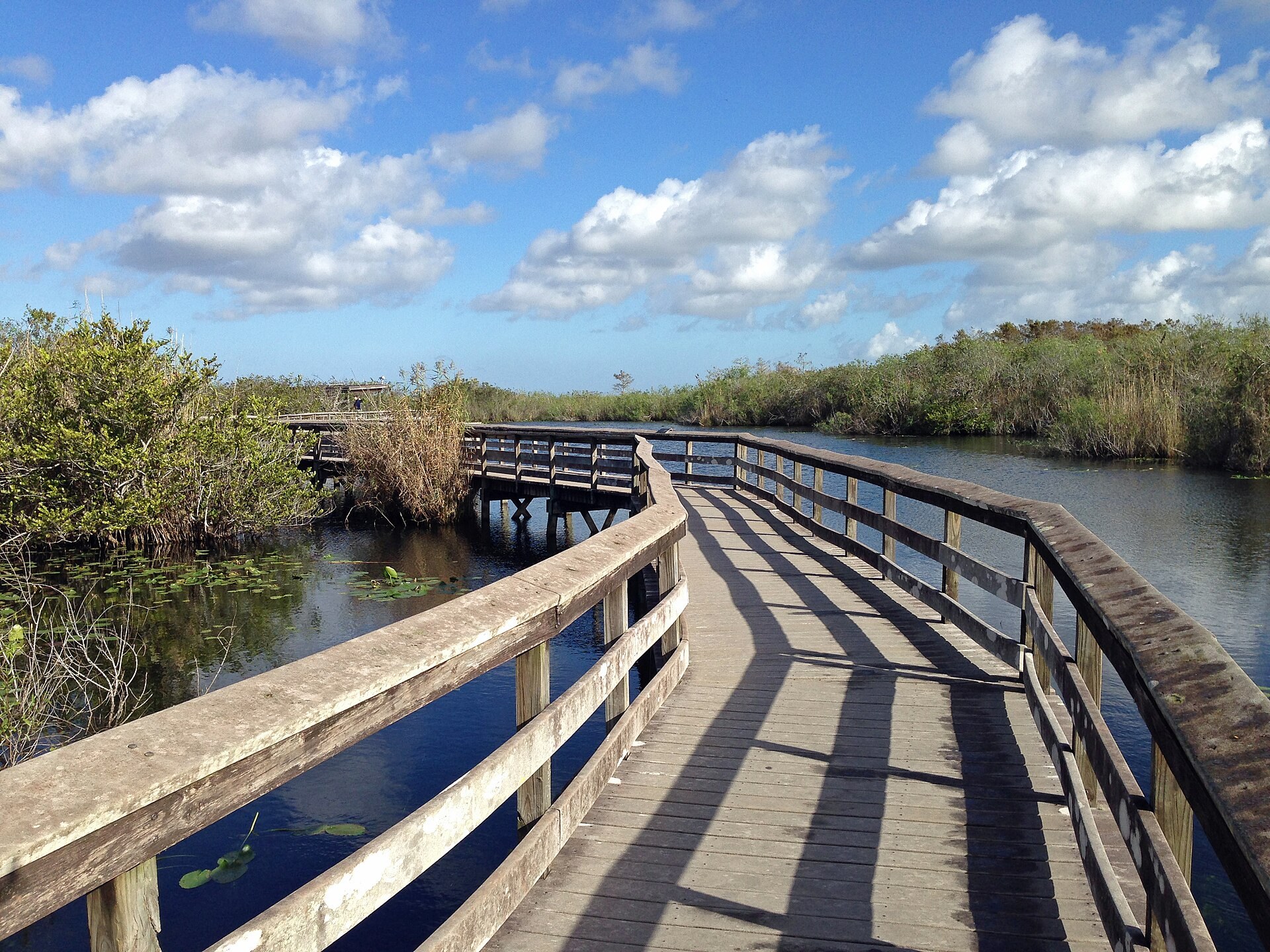
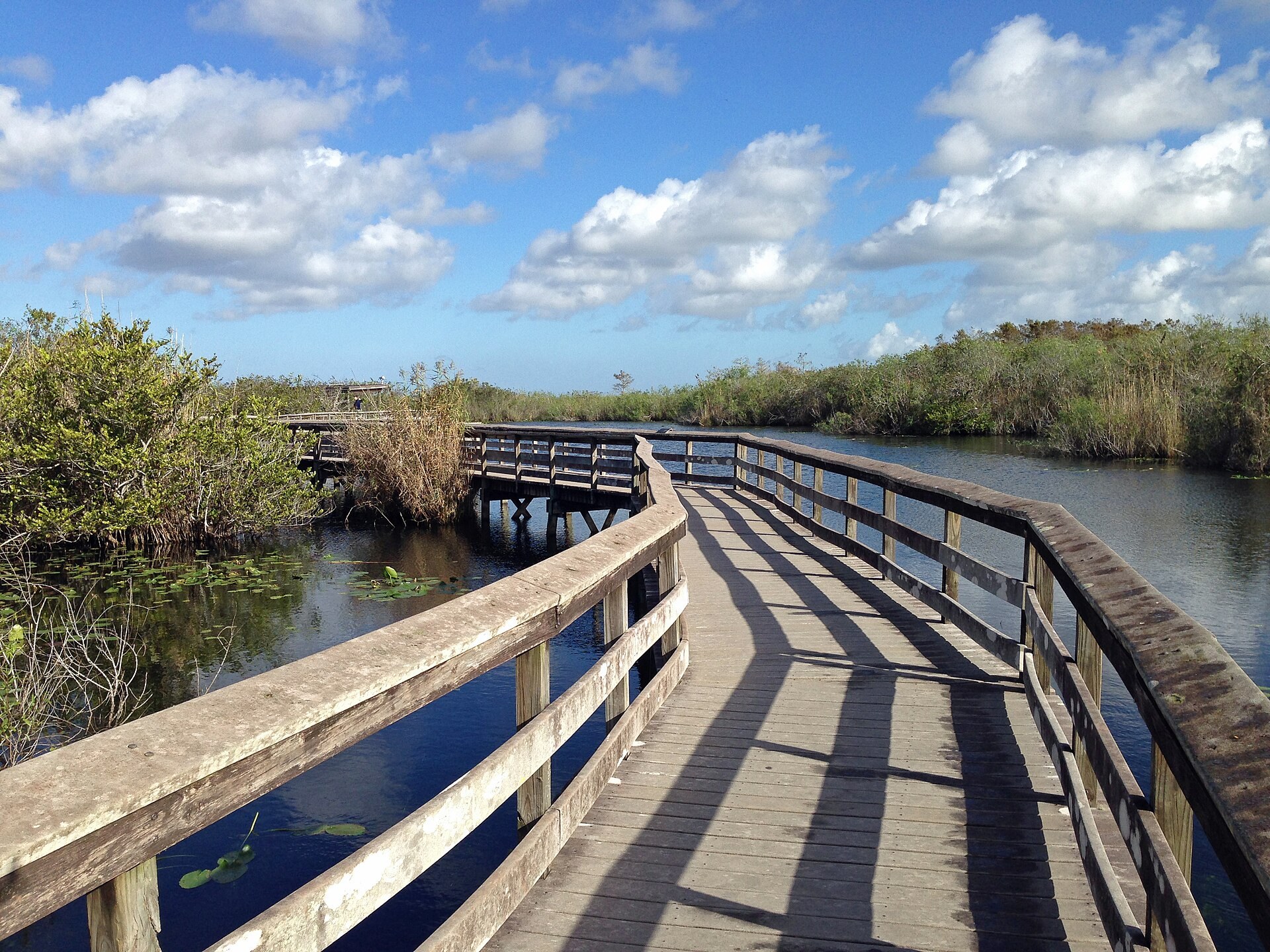
Four miles inside the Homestead gate, Royal Palm is the single best wildlife stop in the park. The Anhinga Trail is a 0.8-mile paved path and boardwalk over Taylor Slough, and in the dry season the water here concentrates everything: alligators stacked on the banks, anhingas drying their wings, great blue herons, purple gallinules, turtles and Florida gar in water clear enough to see them. Go between 8 and 10 a.m. for the most activity and the fewest people.
The Gumbo Limbo Trail next door is a shaded 0.4-mile loop through a hardwood hammock. It is less dramatic but welcome at midday, and it shows you the “tree island” habitat that the rest of the park road passes from a distance. Rangers lead free walks from the Royal Palm parking area in the dry season; the schedule is posted at the visitor center and on the park’s calendar page.
The park road to Flamingo
After Royal Palm, the road settles into a rhythm of short stops. Long Pine Key has picnic tables, a campground and a flat trail network through slash pine. Pa-hay-okee Overlook is a short boardwalk to a raised platform with the widest sawgrass view in the park, the “river of grass” that gives the Everglades its name. Mahogany Hammock is a half-mile boardwalk loop around a massive mahogany tree. Paurotis Pond and Nine Mile Pond are wading-bird roosts, and Nine Mile Pond is also the start of a marked canoe trail. West Lake has a mangrove boardwalk and an accessible viewing deck.
You can do all of them in about two hours of driving and walking. Pick three if you want time at Flamingo.
Flamingo
Flamingo is the end of the road, on Florida Bay, and the only place in the park with a restaurant, a lodge and a marina. The Guy Bradley Visitor Center opened in 2023 with exhibits and a shaded deck, and the marina basin is where visitors see American crocodiles and West Indian manatees from the seawall. The crocodiles are the reason the Everglades is the only place on earth where alligators and crocodiles share habitat; crocs prefer the brackish south end, gators the freshwater north.
The concessioner, Flamingo Adventures, runs backcountry boat tours into Whitewater Bay and bay tours onto Florida Bay, each around 90 minutes, and rents canoes, kayaks, bikes and fishing skiffs. Boat tour prices sit in the $40 range for adults; check the current rate and book ahead in winter. Eco-tents and lodge rooms at Flamingo Lodge let you sleep inside the park, which puts you at the Anhinga Trail at dawn without a second drive from Miami.
Shark Valley
The two-hour narrated tram tour runs on the 15-mile loop and stops at the 65-foot observation tower, where you can see 20 miles of sawgrass in every direction. Shark Valley Tram Tours operates it, with tickets around $30 for adults and departures on the hour in the dry season; reserve online, because winter weekend trams sell out. Bike rentals are available at the same office and the loop is flat, paved and car-free, so a three-hour ride suits most fitness levels. Bring your own bike if you have one; there is no fee beyond entry.
Walkers can take the short Bobcat Boardwalk and Otter Cave Hammock trails near the visitor center without committing to the full loop.
Gulf Coast and the Ten Thousand Islands
From Everglades City the park is mostly water. Boat tours leave from the Gulf Coast area into the mangrove islands, where dolphins, ospreys and manatees are common. Kayak rentals and guided paddles are the other option. This entrance has no walking trails of note, so only make the drive if a boat is the plan.
Airboats: where they are and are not
Airboats are not allowed in the main body of Everglades National Park, which surprises visitors who assumed the two were the same thing. Three operators on Tamiami Trail (Coopertown Airboats, Everglades Safari Park and Gator Park) sit inside the 1989 park expansion area and hold NPS authorization to run airboat rides there. They are 15 to 25 minutes east of Shark Valley, which makes a morning tram and an afternoon airboat an easy combination. Rides generally run 30 to 60 minutes; prices and hours change, so confirm with the operator you choose.
Everywhere else in the park, you are on foot, on a bike or in a quiet boat. That is by design, and it is why the Anhinga Trail still has birds within arm’s reach.
Best time to go
The dry season, December through April, is the answer for almost everyone. Water levels fall, wildlife crowds the remaining pools, mosquitoes drop to tolerable, afternoon highs sit in the 70s and low 80s, and every ranger program, tour and rental is running. January and February are the sweet spot for birds. The trade-off is crowds: Shark Valley’s lot, Royal Palm on weekends, and tram and boat tours all require an early start or a reservation between Christmas and spring break.
The wet season, May through November, is a different park. Mosquitoes at Flamingo and on the Gulf Coast can be severe enough that visitor centers post a “mosquito meter” at the door, and the park sometimes rates it “hysterical.” Afternoon thunderstorms arrive like clockwork around 2 to 4 p.m., humidity is heavy, and wildlife disperses across the flooded marsh. Still, summer has its case: the sawgrass is green, cloud formations are enormous, and you can have the Anhinga Trail to yourself at 8 a.m. Plan a morning-only trip, bring repellent and long sleeves, and skip Flamingo unless you are heading out on a boat.
Hurricane season runs June through November, and the park closes roads and facilities ahead of storms and sometimes for weeks after. Check the current conditions page before any summer or autumn visit.
Local tip
Stop at Robert Is Here, the fruit stand at 19200 SW 344th Street in Florida City, on the way out of the Homestead entrance. The key lime milkshake is the standard reward after a Flamingo day, and the Publix in Homestead is the last full grocery if you are packing a cooler; check that week’s “publix bogo” deals for drinks and snacks before you go.
Wildlife, safety and park rules
Alligators are everywhere in the dry season and are not aggressive toward people who keep their distance. Stay at least 15 feet away, keep children beside you on the Anhinga Trail, and never feed any animal; feeding is illegal and it is what turns a wary gator into a dangerous one. The park also hosts pythons, which you are unlikely to see, and Florida panthers, which you will almost certainly not see. Both are part of why the Everglades is listed as a World Heritage Site, an International Biosphere Reserve and a Wetland of International Importance.
Threatened and endangered species you can realistically spot: the American crocodile and West Indian manatee at the Flamingo marina, wood storks at Paurotis Pond, and snail kites along the Shark Valley loop. The Cape Sable seaside sparrow and Florida panther are the park’s famous residents you will read about but not meet.
Pets are allowed only in parking lots, campgrounds and on the paved road shoulders, never on trails or boardwalks. Drones are prohibited. Cell service fades past Royal Palm and is essentially gone at Flamingo, so download maps and tell someone your plan. Heat is the most common medical issue rangers deal with; drink before you are thirsty and get off the open boardwalks by noon in summer.
Common problems and fixes
| Problem | What usually happened | Fix |
|---|---|---|
| Turned away at Shark Valley | Lot full, typically by 10 a.m. in winter | Arrive at opening, return after 2 p.m., or switch to the Homestead entrance |
| Tram or boat tour sold out | Winter weekend demand | Book online with Shark Valley Tram Tours or Flamingo Adventures a week ahead |
| Wipers or trim chewed off | Vultures at Royal Palm or Flamingo | Cover the car with the free tarps and bungees at the lot |
| Swarmed by mosquitoes | Wet-season visit, especially Flamingo | Visit before 10 a.m., wear long sleeves, apply repellent, keep the car moving |
| Saw very little wildlife | Visited midday in summer or during high water | Go at dawn in the dry season and start at the Anhinga Trail |
| No fuel or food | Expected services inside the park | Fill up in Florida City or on SW 8th Street; only Flamingo sells meals |
| Road or facility closed | Storm damage or seasonal reduction | Check the park’s current conditions page and alerts banner before leaving |
Where to stay and what is nearby
Most Miami visitors day-trip, and that works. If you want two days, Homestead and Florida City have the chain hotels on US 1 closest to the gate, Flamingo Lodge and the eco-tents put you inside the park, and Long Pine Key and Flamingo campgrounds take reservations through the park’s concessioner and recreation.gov. Campsites in January and February book out months ahead; summer sites are nearly empty for reasons the mosquito meter explains.
Biscayne National Park’s Dante Fascell Visitor Center at Convoy Point is about 25 minutes from the Coe entrance and makes a natural second morning, with boat trips to the keys and reefs in season. Big Cypress National Preserve’s Oasis Visitor Center on Tamiami Trail, west of Shark Valley, has a boardwalk with alligators that rivals Royal Palm and no entrance fee. And if the family wants sand after a day of sawgrass, the “miami beaches” on the way home are an hour north of the Homestead gate.
When to get help
Call the park’s main line, 305-242-7700, for current road closures, water levels and ranger program schedules; the recorded options cover conditions outside office hours. For backcountry canoe trips, you need a permit from the Flamingo or Gulf Coast visitor centers in person, and a ranger there will talk you out of a route you are not ready for. For injuries or an animal encounter inside the park, call 911; rangers are law enforcement and emergency responders.
FAQ
How far is Everglades National Park from Miami?
The Shark Valley entrance is about 30 miles west of downtown Miami, roughly 45 to 60 minutes by car. The main Homestead entrance is about 45 miles south, roughly an hour. Flamingo, at the end of the park road, is another 38 miles beyond the Homestead gate, so two hours from downtown.
Can you visit Everglades National Park without a car?
Not practically. No public bus enters the park, and ride-share drivers rarely accept a pickup at Flamingo with no signal. Your options are a rental car, a guided tour with hotel pickup, or the City of Homestead’s seasonal weekend trolley to Royal Palm when it runs.
How much does it cost to get into the Everglades?
At the time of writing, $35 per vehicle for seven days, $30 per motorcycle and $20 per pedestrian or cyclist, with children 16 and under free. The $80 America the Beautiful pass covers it. Confirm current fees on the park’s official NPS page, since they are adjusted periodically.
Is one day enough for the Everglades?
Yes for a strong introduction. The Anhinga Trail, three stops on the park road and an hour at Flamingo fit comfortably between 8 a.m. and 4 p.m. Shark Valley alone is a half day. Combining Shark Valley and Flamingo in one day means about four hours of driving, which most people regret.
Which is better, Shark Valley or the Homestead entrance?
Shark Valley for a half day, a bike ride and guaranteed close alligators in winter. Homestead for a full day, the widest range of habitats, boat tours, kayaking, camping and crocodiles. If you can only pick one and have the time, pick Homestead.
Are airboats allowed in Everglades National Park?
Only in the Tamiami Trail strip on the park’s northern edge, where three NPS-authorized operators run rides. The rest of the park, including Shark Valley, Royal Palm and Flamingo, is off-limits to airboats. Airboat tours sold in Miami Beach generally go to those Tamiami Trail operators or to private land outside the park.
When is the best month to visit?
January or February. Water is low, birds and alligators are concentrated, mosquitoes are minimal, and every tour and program is operating. The cost is crowds, so arrive early and reserve trams and boats ahead.
