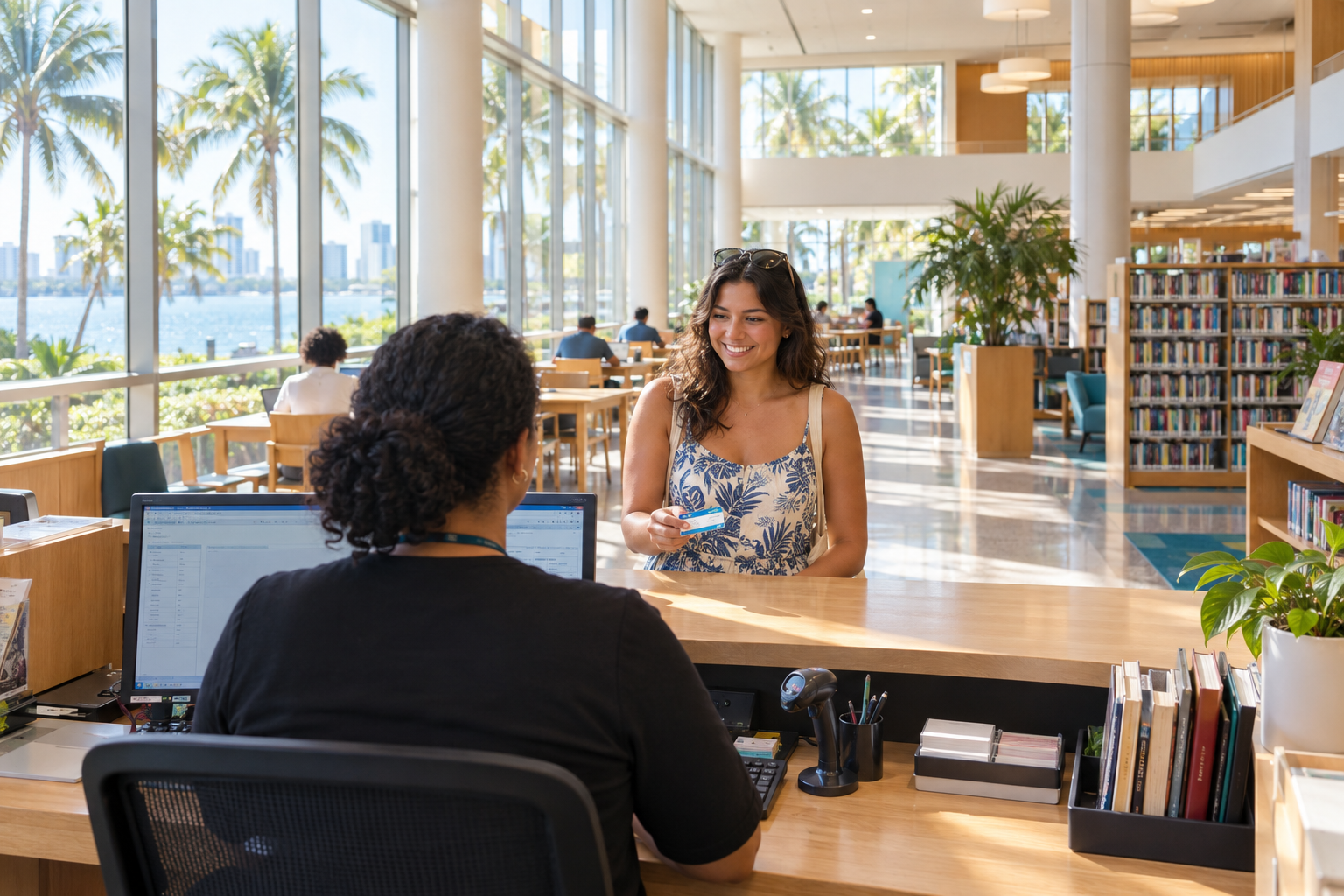
You can get a library card in Broward, Miami-Dade or Palm Beach County without living there, and in most cases you don’t have to pay for it. All three county systems issue free cards to residents of neighboring Southeast Florida counties through a reciprocal borrowing agreement, and each one also sells an annual non-resident card to people from anywhere else. This guide shows who qualifies for free, what a paid card actually includes, and which out-of-state cards are worth buying if you mainly read on Libby.
Before you pay, check for a free card first
Most people searching for a non-resident library card in South Florida already qualify for a free one and don’t know it. The three county systems, plus several city libraries, define “resident” more generously than you’d expect.
Here is the short version by situation:
| Your situation | Miami-Dade Public Library System | Broward County Library | Palm Beach County Library System |
|---|---|---|---|
| Live in the county (inside the library taxing district) | Free | Free | Free |
| Own property in the county but live elsewhere | Free with tax bill or deed | Free with tax bill or deed | Free with tax bill or deed |
| Live in Broward, Miami-Dade, Palm Beach, Martin or Monroe | Free reciprocal card with your home card | Free reciprocal card with your home card | Free reciprocal card with your home card |
| Live elsewhere in Florida or out of state | Paid annual card | Paid annual card | Paid annual card |
| Live in a city with its own library inside the county | Depends on the city | Not applicable | Depends on the city |
Each system posts the exact fee and the current rules on its library card page (look for “Get a Card” or “Library Cards” in the main menu). Fees are set with each county budget and do change, so treat any number you see on a blog as a starting point and confirm before you drive over.
Quick steps: get a free reciprocal card
- Confirm your home library card is active and in good standing.
- Bring that card plus a government photo ID to any branch in the other county.
- Ask for a reciprocal borrowing card at the circulation desk.
- Fill out the short registration form (name, address, phone, email).
- Ask which digital services the card includes before you leave.
- Set up your PIN and test it on the catalog from your phone.
What you need
- Government photo ID (driver license, state ID, passport)
- Proof of your current address if the ID shows an old one
- Your home library card for a reciprocal card
- A property tax bill or deed if you’re applying as a property owner
- A lease, utility bill or bank statement if you’re a seasonal renter
- A parent or guardian present if the applicant is under 18
How the three county systems define a resident
The word “non-resident” means something slightly different at each system, and the difference comes down to taxes. Each county library is funded by a dedicated property tax levied on a library taxing district. If your home is inside that district, you’ve already paid for the library and your card is free. If you’re outside it, the system either charges you or waives the fee under an agreement.
Miami-Dade Public Library System
Miami-Dade’s library taxing district covers most, but not all, of the county. A few municipalities opted out decades ago and run their own libraries, so their residents are technically non-residents of the county system. Hialeah, North Miami, North Miami Beach, Surfside and Bal Harbour are the ones people trip over most often. If you live in one of those cities, you get a free card from your city library, and you can still use the county system by paying the non-resident fee or by qualifying through the reciprocal program with your city card (ask, since participation varies by city).
Residents inside the district register free. You can apply in person at any of the branches, including the “miami dade main library” downtown, or start online and pick up the physical card later. Property owners who live elsewhere qualify by bringing a tax bill or deed showing the Miami-Dade property.
For everyone else, MDPLS sells a non-resident card that renews annually. The current fee is listed on the system’s library card page, along with the payment methods each branch accepts. The card gives you full borrowing privileges at all branches and, as of the last time I renewed one for a relative, access to the e-book and streaming platforms as well. Always ask at the desk, because digital access for paid cards is the rule most likely to change when a vendor contract gets renegotiated.
Broward County Library
Broward is the simplest of the three because the county library serves every city in Broward. There are no opt-out municipalities, so if you live anywhere from Deerfield Beach to Hallandale Beach and out to Weston, you’re a resident and the card is free.
Broward issues free cards to:
- Anyone with a Broward address, proven with ID or a recent bill
- Property owners who live elsewhere, with a tax bill or deed
- Residents of Miami-Dade, Palm Beach, Martin and Monroe through reciprocal borrowing
- Broward County Public Schools students through the student card partnership
Non-residents from outside those categories pay an annual fee. Broward has historically kept its fee modest compared with large systems in other states, and it has treated the paid card as a full card rather than a stripped-down version. Confirm both points on the Broward County Library “Library Cards” page or by calling the branch nearest you, because the phone number for each branch is listed on its own page and the staff there answer card questions all day.
Palm Beach County Library System
Palm Beach County is the one where “non-resident” catches locals off guard. The county library taxing district excludes cities that run their own public libraries, and there are a lot of them. Boca Raton, Delray Beach, Boynton Beach, Lake Worth Beach, West Palm Beach (the Mandel Public Library), Palm Springs, Lantana, Riviera Beach, North Palm Beach, Lake Park and Highland Beach all run independent libraries. If your address is inside one of those city limits, you are a non-resident of the county system even though you live in Palm Beach County.
That sounds worse than it is. Most of those city libraries participate in reciprocal borrowing with the county, so you present your city card at a county branch and get a county card free. The reverse works too: county cardholders can use participating city libraries. Each city sets its own policy, though, so a city card from one municipality might get you a free county card while another doesn’t. Ask your city library first.
Residents of unincorporated Palm Beach County and of cities without their own library (Wellington, Royal Palm Beach, Jupiter, Palm Beach Gardens, Greenacres and most of the western communities) register free with the county system. Residents of Broward, Miami-Dade, Martin and Monroe qualify through the regional reciprocal agreement. Everyone else pays the annual non-resident fee, which Palm Beach County publishes on its library card page.
Local tip
If you live in Boca Raton, Delray Beach or Boynton Beach and want a card that works in Broward, don’t bother with Broward’s non-resident fee. Get your free county card through your city’s reciprocal arrangement first, then use that county card for a free Broward reciprocal card. Two visits, zero dollars.
Reciprocal borrowing across Southeast Florida
The free-card arrangement that makes all of this work is coordinated through the Southeast Florida Library Information Network, usually shortened to SEFLIN, a cooperative based in Boca Raton. Its reciprocal borrowing program lets cardholders of participating public libraries in Broward, Miami-Dade, Palm Beach, Martin and Monroe counties borrow from each other without paying non-resident fees.
The way it works in practice:
- You hold a card in good standing from a participating library (your home library).
- You visit a branch of another participating library and show that card plus photo ID.
- The second library issues you its own card, usually marked as a reciprocal or courtesy card.
- You follow the second library’s loan rules, fines and renewal limits, not your home library’s.
Three things catch people out.
The card is issued by the second library, not shared. You’ll end up with a separate card number and PIN for each system. That’s actually useful for Libby, covered below, but it means keeping track of multiple accounts.
Digital services are the most commonly excluded item. Libraries pay vendors per cardholder or per checkout for e-books, audiobooks and streaming video. Some systems therefore limit reciprocal cards to physical materials, or allow Libby but not hoopla, or allow both but block museum passes and other high-demand perks. The policy differs by system and shifts year to year, so ask the person issuing the card exactly what it covers.
Your home card has to be clean. If you owe fines or have a lost item on your home account, the second library can decline the reciprocal card. Clear your home account first.
Membership in the program isn’t limited to the three big county systems. Several city libraries in Miami-Dade and Palm Beach counties participate, and so do the Martin County Library System and the Monroe County Public Library in the Keys. The current participant list is maintained by SEFLIN and mirrored on member library card pages. If a library isn’t on the list, its card won’t get you a free reciprocal card elsewhere.
Seasonal residents, second-home owners and commuters
South Florida has a huge population of people who are here for part of the year, and every library system has rules built for them.
Snowbirds and seasonal renters
If you rent for the season, you’re a resident for library purposes as long as you can show a local address. A signed lease, a utility bill in your name or a bank statement mailed to the Florida address will do. Your out-of-state driver license is fine for the photo ID half of the requirement. Some branches will put an expiration date on a seasonal card matching your lease; others issue a standard card and let it expire on the normal cycle.
If you own the condo, you’re a property owner and qualify free at all three county systems with a tax bill or deed, regardless of where you spend the rest of the year. People planning their first winter down here often ask what months to book; the pattern in “west palm beach weather” by month is a reasonable guide for the whole coast.
People who work or study in the county
Policies here vary and this is worth a direct question at the desk. Some systems issue free or reduced-fee cards to people employed in the county on proof of employment (a pay stub or employer letter). College students enrolled at institutions in the county, including FIU, FAU, Nova Southeastern, Miami Dade College and Broward College, can usually get a public library card with a current student ID and proof of a local address, even a dorm address. K-12 students in the three public school districts are covered by student card partnerships that use the school ID number as a library account, with digital access included.
Military, Tribal and other special categories
Active-duty military stationed in the area register with orders showing the local assignment. Residents of the Miccosukee and Seminole reservations within county boundaries register as county residents. If you’re in a category that doesn’t fit neatly, ask for a supervisor at a larger regional branch rather than a small neighborhood branch; they see edge cases more often.
What a paid non-resident card includes
When you do have to pay, you want to know what you’re buying. Here’s how the three county cards compare on the things that matter most to someone who doesn’t live nearby. Confirm the specifics for the current year on each system’s card page.
| Feature | Miami-Dade | Broward | Palm Beach County |
|---|---|---|---|
| Term | 1 year, renewable | 1 year, renewable | 1 year, renewable |
| Physical checkouts at all branches | Yes | Yes | Yes |
| Holds and interbranch transfers | Yes | Yes | Yes |
| Libby (OverDrive) e-books and audiobooks | Generally yes; confirm | Generally yes; confirm | Generally yes; confirm |
| hoopla and streaming video | Varies by year; confirm | Varies by year; confirm | Varies by year; confirm |
| Online research databases | Yes | Yes | Yes |
| Museum and attraction passes | Usually residents only | Usually residents only | Usually residents only |
| Where to apply | Any branch in person | Any branch in person | Any branch in person |
| Payment | Card page lists methods | Card page lists methods | Card page lists methods |
A few notes on that table.
Research databases, including genealogy tools, auto repair manuals, language courses and newspaper archives, are the part of a paid card people undervalue. Most of them work from home once you log in with your card number, and they’re expensive to buy individually.
The “library passes for museums” programs run by South Florida libraries are funded with local dollars and are typically reserved for taxing-district residents. Don’t buy a non-resident card expecting free Frost Museum or Zoo Miami admission.
Payment is in person at the desk for all three. None of the three county systems currently lets you buy a non-resident card entirely online, which is the big difference from the out-of-state cards covered next. If you’re already in the area for the season, that’s a minor inconvenience. If you live in Ohio and want a Florida card for Libby, it’s a deal-breaker, and you should look at the libraries that sell online instead.
Good to know
Non-resident fees are non-refundable, and the card expires one year from the purchase date, not at the end of the calendar year. If you buy in March and leave in April, you’ve paid for eleven months you won’t use. Buy when you arrive, not when you’re packing.
Out-of-state library cards you can buy entirely online
If you’re reading this from outside Florida, or you’re a Floridian who wants more Libby catalogs, the better move is often a card from a library that sells to anyone, with online registration and online payment. These are the ones that stand out for digital access. The fees below are the published rates at the time of writing; every one of these libraries lists the current price on its card page, and they do go up.
| Library | Published annual fee | Online signup | Digital highlights |
|---|---|---|---|
| Brooklyn Public Library (NY) | About $50 | Yes | Large Libby catalog, strong audiobook selection |
| Queens Public Library (NY) | About $50 | Yes | Libby, hoopla, research databases |
| Houston Public Library (TX) | About $40 | Yes, with mailed card | Libby, hoopla, Kanopy |
| Fairfax County Public Library (VA) | About $27 | Yes | Libby, hoopla, Kanopy, deep database set |
| Orange County Library System (Orlando, FL) | About $125 | Yes | Libby, hoopla, Kanopy, large Spanish-language collection |
How to pick among them:
Pick on catalog size if you mostly read new releases. Brooklyn and Queens have very large Libby collections and shorter waits on bestsellers than most Florida systems. If a title has a 14-week hold in Broward, it might be 4 weeks in Brooklyn.
Pick Fairfax if you want the cheapest broad card. At its published rate it’s the best value on the list, with hoopla included, and hoopla’s no-waitlist model is where a second card pays off fastest.
Pick Houston if you also want a physical card mailed to you. Houston mails the card, which some apps require for initial setup.
Skip Orlando unless you’re in Central Florida regularly. Orange County’s fee is set to recover the cost of serving non-taxpayers, and its catalog overlaps heavily with what Miami-Dade, Broward and Palm Beach already give you free. It makes sense for people who drive up for theme parks every month and want physical checkouts, not as a Libby-only purchase.
Before buying any of these, check two things on the library’s own card page: whether the digital services you care about are included for non-residents (some libraries exclude hoopla for paid cards because of its per-checkout cost), and whether the card has to be renewed in person (a handful require a one-time in-person visit for the first card). The ranking lists you’ll find elsewhere go stale quickly because libraries cut non-resident programs when budgets tighten.
Local tip
A free card from a neighboring South Florida county is worth more than most paid out-of-state cards. Three county systems means three separate Libby holds lists and three copies of every popular audiobook. Collect all three reciprocal cards before you spend a dollar on a card from another state.
How to add a non-resident card to Libby
Libby, the OverDrive app, supports multiple library cards in one account, and that’s the main reason people collect non-resident cards. Each card you add gives you that library’s full catalog, its hold limits and its loan periods, and the app merges everything into one shelf.
Quick steps: add a second card in Libby
- Open Libby and tap the menu icon (the three lines or the Libby face, depending on version).
- Choose “Add a Library” and search by the library’s name or city.
- Tap “Sign In With My Card” and enter the card number and PIN exactly as issued.
- Confirm the sign-in and name the card something you’ll recognize, like “Broward recip.”
- Repeat for each additional library.
- On any title, tap “Borrow” and pick which card to use if several libraries own it.
- Use “Manage Cards” in the menu to see all cards and renew expired ones.
A few things to know once you have multiple cards loaded:
- Each library counts your loans and holds separately. Five Libby holds on your Miami-Dade card don’t reduce the holds available on your Palm Beach card.
- When you search in Libby, you search one library at a time. Switch libraries with the library name at the top of the screen. The “Library Extras” and “Tags” features let you tag a title and see which of your libraries owns it.
- A reciprocal card that expires will show as blocked in Libby. The fix is usually a visit to any branch of that system with your home card to renew, not a new application.
- Kindle delivery works the same for every card, since it’s an Amazon handoff from OverDrive, not a library setting.
hoopla works differently. It allows one library per account, so if you want hoopla access from a second library you’ll need a second hoopla login tied to that card. Kanopy also ties one library per login but lets you switch between them inside the app.
Free statewide resources every Floridian already has
Two things are free to every Florida resident regardless of which county they live in, and they fill some of the gaps a non-resident card is meant to cover.
The Florida Electronic Library is a state-funded set of research databases you can use from home with no library card at all; it verifies that you’re in Florida by location. It covers newspaper and magazine archives, academic journals, health references, business data and homework help. It won’t give you e-books or audiobooks, but if the reason you wanted a second card was research, start here.
Interlibrary loan through your home library lets you borrow physical books from other Florida libraries, and often from libraries nationwide, at no cost or for a small handling fee. It’s slower than a reciprocal card (allow one to three weeks), but it means a book held only by Palm Beach County can still reach you at a Miami-Dade branch without a second card. Ask at the reference desk; it’s rarely advertised on the front page.
Most city libraries in the three counties also let non-cardholders use computers and read in the building. You need a card to check out, not to sit down.
Applying in person: what to expect at the desk
For a free resident or reciprocal card, the whole process takes about 15 minutes. You’ll fill out a form with your name, address, phone, email and a PIN of your choosing (four digits at most systems). Staff will scan your ID, check the address against the taxing district map, and print a card on the spot. Some branches issue a key-tag version too.
For a paid non-resident card, add the payment step. Ask which methods the branch accepts before you get in line; smaller branches in all three systems are sometimes cash-free or card-only, and the card page for each system states the policy.
If you want to start the paperwork from home first, the “online library card” process in South Florida gets you a temporary digital account at all three county systems. For residents it converts to a full card when you show ID. For non-residents it’s a time-saver that pre-fills the form, but you still pay and verify in person.
Larger regional branches handle card questions faster than storefront branches because they have more staff at the desk. In Broward, the Main Library in downtown Fort Lauderdale and the regional branches in Pembroke Pines, Coral Springs and Pompano Beach are good choices. In Miami-Dade, the Main Library downtown and the regional branches in West Kendall, Northeast Dade (Aventura) and South Dade handle the most unusual residency cases. In Palm Beach County, the Main Library on Summit Boulevard in West Palm Beach and the branches in Wellington, Boca Raton (the county’s West Boca branch, not the city’s), Jupiter and Lantana Road serve the largest areas. Parking at all of these is free in surface lots, except the two downtown main libraries, where you’ll use metered street parking or a nearby garage.
Common problems and fixes
| Problem | Why it happens | What to do |
|---|---|---|
| Told you’re a non-resident even though you live in the county | Your city runs its own library and opted out of the county taxing district | Get a card from your city library first, then ask about reciprocal county access |
| Reciprocal card refused | Fines, a lost item or an expired home card | Clear the home account, then reapply with the updated card |
| Libby says your card is invalid | Reciprocal cards have shorter expirations than resident cards | Renew in person at any branch of that system with your home card |
| Paid card won’t work on hoopla | Some systems exclude hoopla for non-residents due to per-checkout costs | Confirm on the card page before buying; use Libby and databases instead |
| Can’t pay the non-resident fee online | All three county systems take payment in person only | Plan a branch visit or buy an out-of-state card that sells online |
| Museum passes unavailable on your card | Passes are funded for taxing-district residents | Use a resident friend’s card for passes; keep yours for books and digital |
| Seasonal card expired mid-stay | Branch set the expiration to the lease end date | Bring the renewed lease or a new bill to any branch to extend |
| Student card doesn’t work at a different county’s library | Student partnerships are county-specific | Apply for a regular card with a parent and ID |
When to get help
Call the branch directly when your address sits on a city boundary, when you’re applying as a property owner with a trust or LLC on the deed, or when a reciprocal card gets refused and you don’t know why. Branch phone numbers are listed on each branch’s page on the county library site. For disputes about fines on a home account that’s blocking a reciprocal card, ask for the circulation supervisor at your home library, not at the library you’re trying to join; only your home library can clear the block.
Which option is right for you
To save you working through all the sections above, here’s the decision in plain terms.
If you live in any of the five Southeast Florida counties, get free reciprocal cards from the other systems. Visit a branch with your home card and ID. That gives you three Libby catalogs, three holds lists and physical borrowing anywhere from the Keys to Jupiter for nothing.
If you own property in one of the counties but live elsewhere, apply as a property owner with your tax bill. It’s free and it’s a full card.
If you rent for the season, bring your lease and apply as a resident. Renew each year when you arrive.
If you live in a Palm Beach city with its own library, get your city card, then your county card through reciprocal access, then Broward and Miami-Dade through the regional agreement. Three stops, no fees.
If you live elsewhere in Florida or out of state and want physical borrowing in South Florida, buy the non-resident card from the system whose branches you’ll actually visit. Time the purchase for the start of your stay.
If you live anywhere and only want more Libby titles, skip the three county non-resident cards (in-person payment only) and buy a card from Queens or Fairfax online; Brooklyn no longer sells an out-of-state card, and Houston stopped accepting non-Texas-resident applications and renewals as of April 7, 2025. Check that library’s current fee and digital inclusions on its own card page first.
FAQ
Can I get a library card without being a resident?
Yes. In Broward, Miami-Dade and Palm Beach County, non-residents can buy an annual card at any branch, and residents of the neighboring counties (Broward, Miami-Dade, Palm Beach, Martin and Monroe) can get one free by showing their home library card. Property owners, seasonal renters with a lease, and students or employees in the county usually qualify for a resident card as well. The current fee for a paid card is on each system’s library card page.
Are there free non-resident library cards available in Texas?
Not for people outside Texas. Texas runs a statewide program called TexShare that lets Texas residents borrow from participating libraries across the state using a TexShare card issued by their home library, but it requires a Texas home library. For non-Texans, the most-used option is Houston Public Library’s paid non-resident card, which can be bought online and includes Libby and hoopla access. A few other Texas systems sell non-resident cards; check each library’s card page for the current price and whether online registration is offered.
Can non-NYC residents get a library card?
Yes, in two ways. If you live, work, attend school or pay property taxes anywhere in New York State, the New York Public Library, Brooklyn Public Library and Queens Public Library issue cards free. If you’re outside New York State, Queens sells an out-of-state card with online signup and a published annual fee ($50 per year at the time of writing; confirm on its site), while Brooklyn has discontinued its fee-based out-of-state card entirely. This card includes Libby access and is popular with South Florida readers who want shorter waits on new releases.
How can I get a non-resident library card in Ohio?
Ohio residents can get a card at essentially any public library in the state, because Ohio funds libraries statewide and most systems honor residents from any Ohio county. For people outside Ohio, options are limited; most Ohio libraries don’t sell non-resident cards, and the few that do typically require an in-person visit. If you’re a Floridian hoping for an Ohio card for Libby, you’ll usually do better with the out-of-state cards sold online by libraries in New York, Virginia or Texas listed above.
Does a reciprocal card include Libby and hoopla?
Sometimes. Libby access is usually included with reciprocal cards in the three South Florida county systems, but hoopla, Kanopy and museum passes are the items most often restricted to taxing-district residents. Ask the person issuing the card exactly which services it covers, and recheck each year, because the vendor contracts behind these services are renegotiated regularly.
How much does a non-resident library card cost in South Florida?
Each of the three county systems sets its own annual fee, and the amounts change with county budgets. Broward and Miami-Dade have kept theirs comparatively low; Palm Beach County’s has historically run higher. The current figures are posted on each system’s library card page, and the branch staff can tell you by phone. Before paying, check the free-card table at the top of this guide, because most people who ask qualify for a free card through residency, property ownership or reciprocal borrowing.
Can I buy a South Florida non-resident card online?
No. All three county systems require in-person payment and ID verification for non-resident cards, though you can start the registration form online to save time at the desk. If you need a card you can buy and use entirely online, look at the out-of-state libraries that sell cards with online signup.