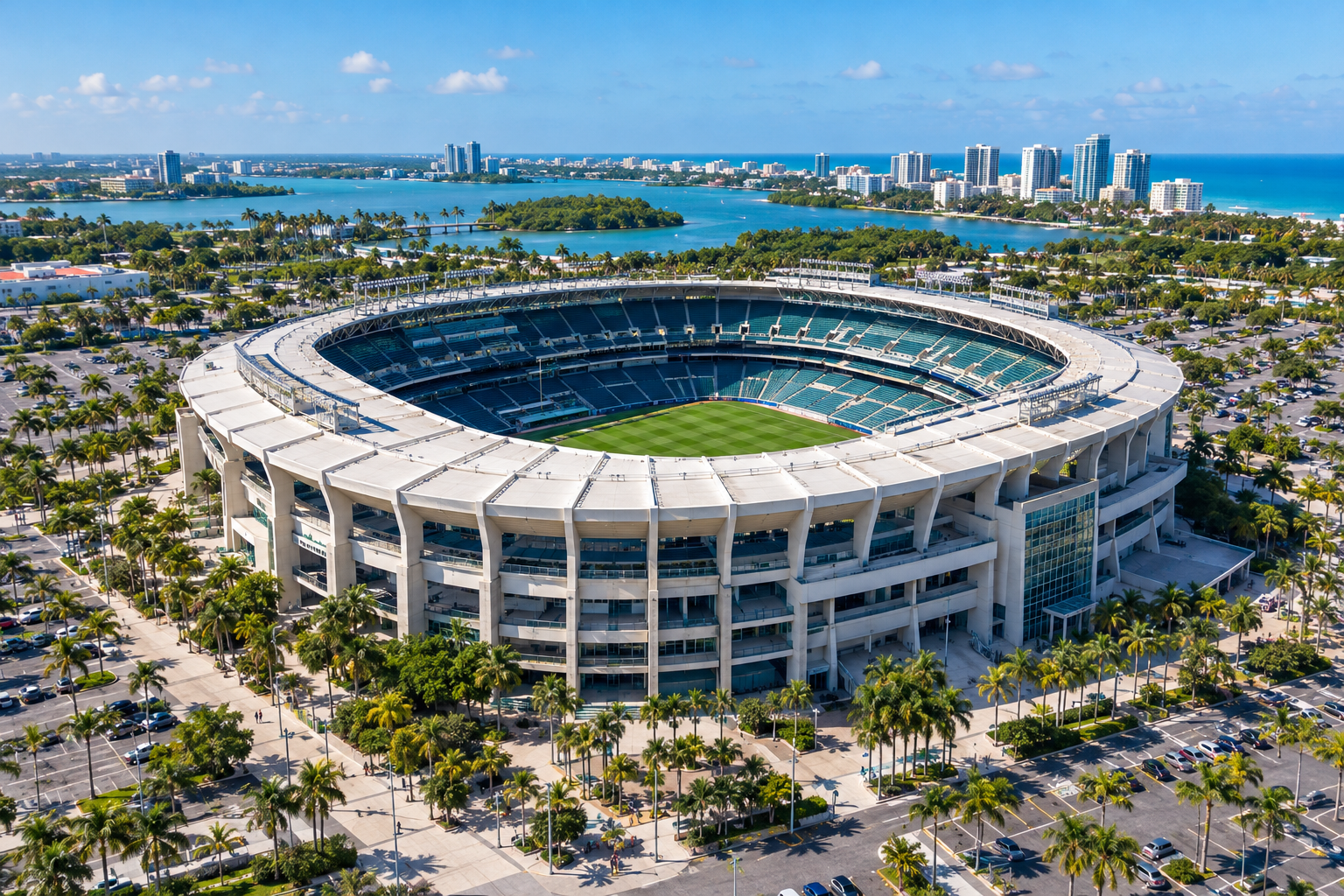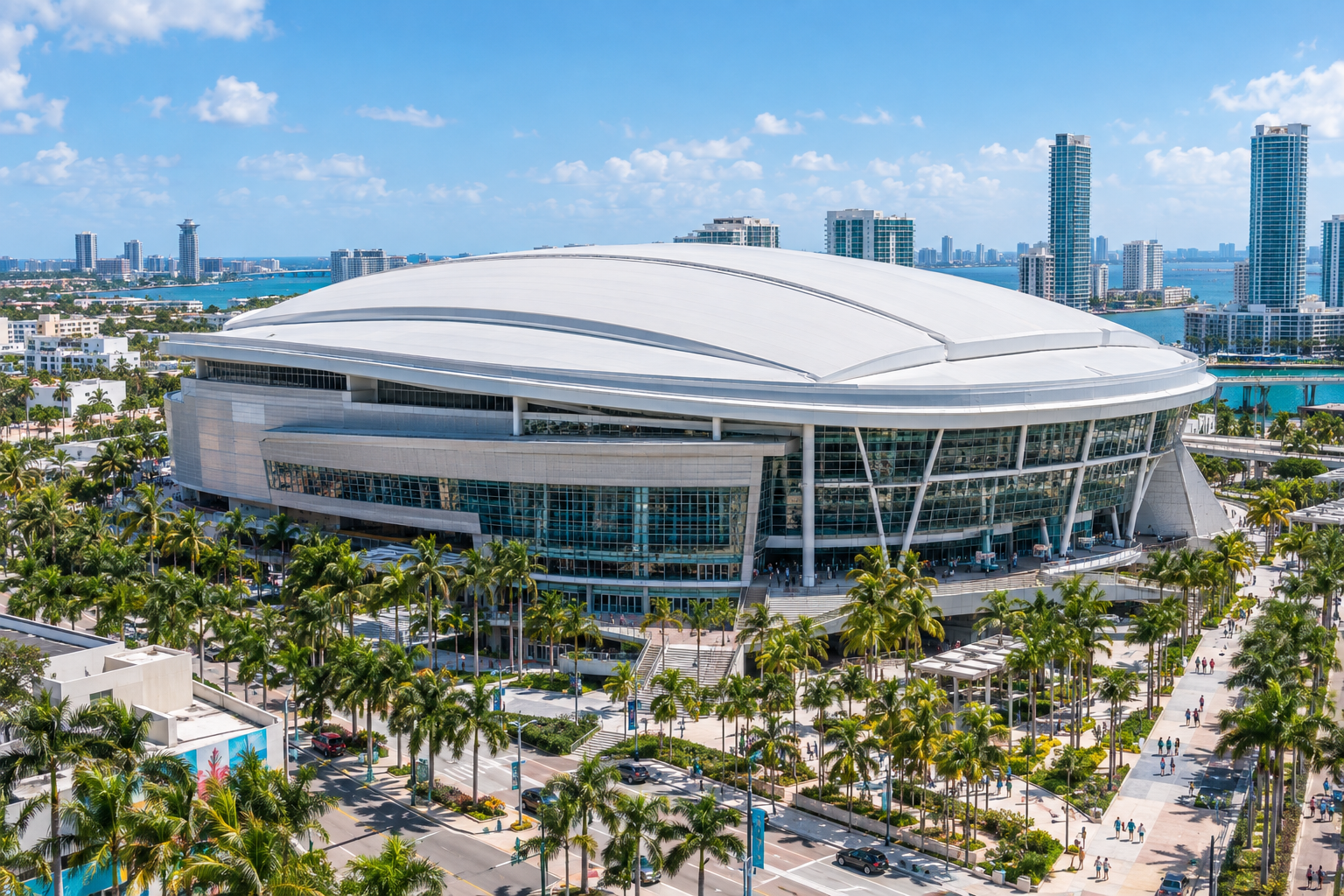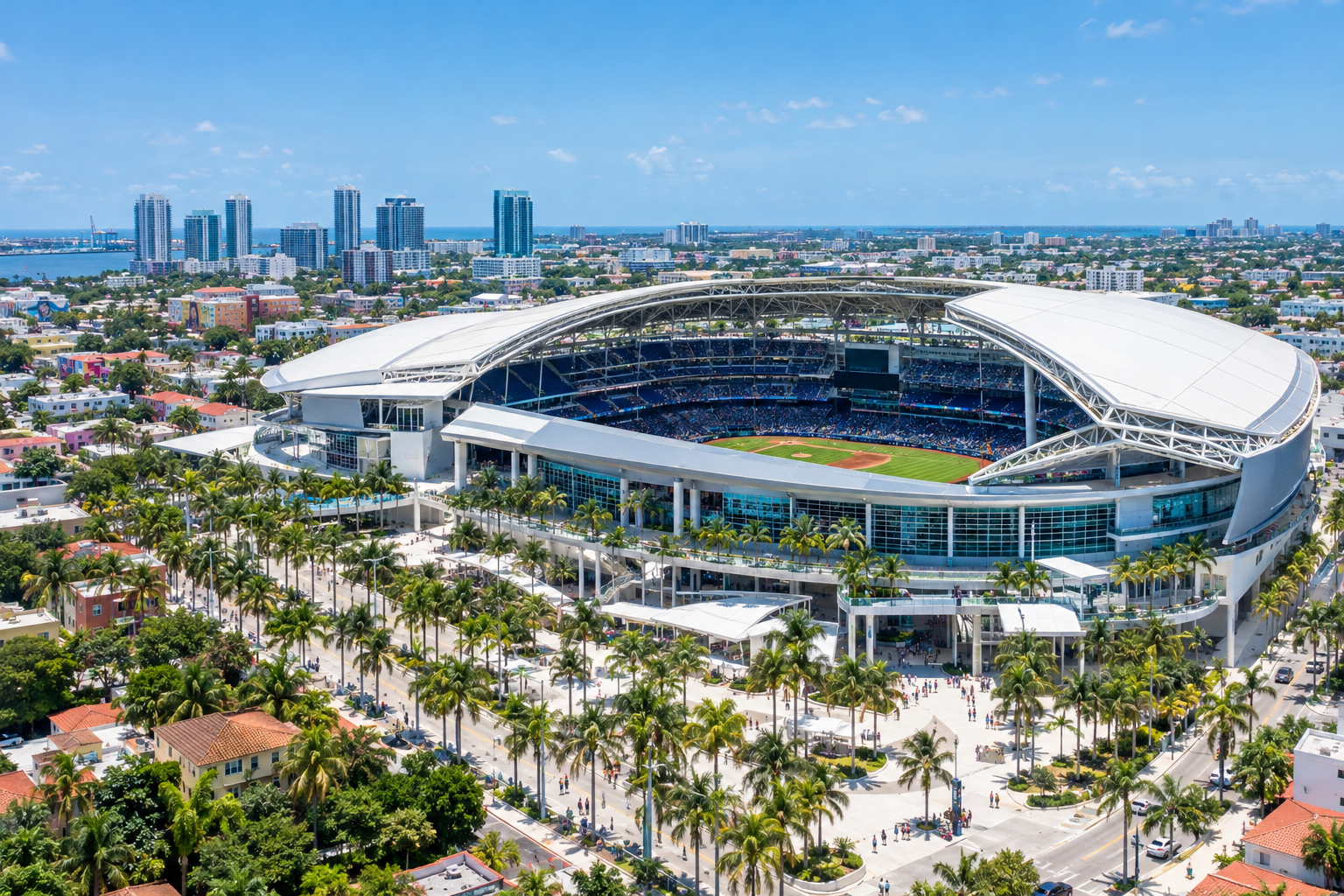
The Miami Marlins are South Florida’s Major League Baseball club, playing 81 home games a season at loanDepot park on the old Orange Bowl site in Little Havana, with spring training up the coast in Jupiter. We put together this guide for residents and visitors who want to buy tickets, get to the ballpark without a parking headache, and understand how a franchise born as the Florida Marlins ended up with two World Series trophies and the youngest roster in the National League East.
Who the Marlins are
The club joined the National League as an expansion team in 1993 and has played in the NL East ever since, sharing the division with the Braves, Phillies, Mets and Nationals. Their home since 2012 is a retractable-roof ballpark at 501 Marlins Way in Miami, roughly two miles west of downtown and a short drive from Calle Ocho, built where the Orange Bowl stood for 70 years.
Ownership belongs to a group led by Bruce Sherman, which bought the team in 2017 and ran it with Derek Jeter as chief executive until his exit in early 2022. Peter Bendix, hired from the Tampa Bay Rays in late 2023, runs baseball operations as president, and Clayton McCullough took over as manager ahead of the 2025 season after Skip Schumaker departed following two years in the dugout.
What makes the Marlins unusual as a local resource is price and comfort. Attendance sits near the bottom of the majors most seasons, which means walk-up seats are easy to find, and the closed roof keeps the building in the low 70s on August nights when every other outdoor venue in Miami-Dade is sweltering.
Getting tickets
Quick steps: buying Marlins tickets
- Download the MLB Ballpark app and create a free account.
- Check the promotional schedule on the team’s site for giveaway and fireworks dates.
- Pick a section: upper deck for value, Legends Level behind home plate for comfort.
- Buy through the Marlins’ official ticket page or the app; resale listings appear there too.
- Add prepaid parking in the same checkout if you are driving.
- Open the app before you reach the gate so your barcode loads without cell service.
What you need
- Smartphone with the MLB Ballpark app installed
- Card or digital wallet (the ballpark runs cashless)
- Prepaid parking confirmation or a transit plan
- Clear or small bag that meets the posted size rules
Every Marlins ticket is digital and delivered through the MLB Ballpark app, including resale purchases, so printed PDFs and screenshots do not scan at the turnstiles. We buy direct from the team’s ticket office rather than third-party brokers because face value for upper-level seats on weeknights regularly lands under $20, and the Marlins run frequent flash deals and group packages that brokers cannot beat.
Price tiers move with the opponent and the calendar. A Tuesday against the Rockies in May costs a fraction of a Saturday against the Yankees or Dodgers, and the Phillies and Mets series draw large travelling crowds from the Northeast that push resale prices up. Promotional nights matter here more than in most markets; bobblehead giveaways and postgame fireworks reliably double a crowd, so arrive early on those dates if you want the item.
The ticket office at the ballpark also sells in person on game days, and the team’s official site lists current hours, pricing categories and the full promotional schedule. Prices and policies change every offseason, so we treat anything older than a few months as a guess and confirm on the team’s site before telling anyone what a seat costs.
Getting to loanDepot park and parking
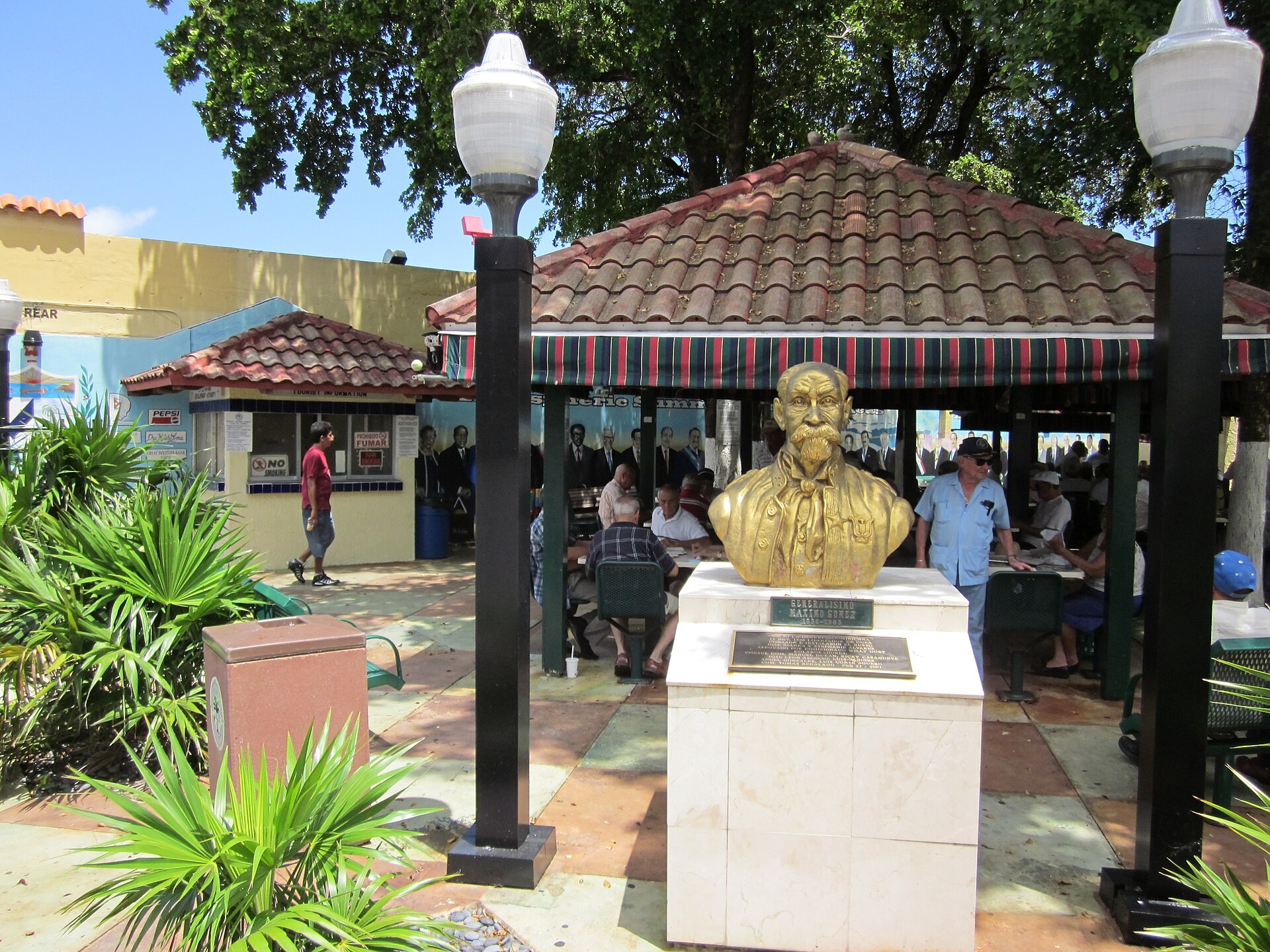
The ballpark sits between NW 3rd Street and NW 7th Street, bounded by NW 14th and NW 16th Avenues, in the eastern part of Little Havana. From the east you come in along Flagler Street or NW 7th Street from Brickell and downtown; from the west, SW 8th Street (Calle Ocho) delivers you within a few blocks. Dolphin Expressway (SR 836) exits at NW 12th or 17th Avenue are the fastest route from “miami international airport“, which sits about five miles northwest, and from the western suburbs.
Four city-owned garages ring the stadium, plus surface lots, and we strongly recommend prepaying through the team’s parking page because garage prices climb on the day and the closest structures sell out for weekend games. Expect to pay in the $20 range for a standard garage spot on a regular game, more for premium games, with the exact figure listed at checkout. Neighbourhood residents also rent driveway and lawn spots on surrounding streets for cash, a tradition carried over from Orange Bowl football days; it works, but keep in mind these are private arrangements with no attendant.
Transit is the weak point. There is no Metrorail station within comfortable walking distance, so rail riders should plan to connect to a Metrobus along Flagler Street or NW 7th Street, or to the free Miami Trolley’s Little Havana route, which stops near the ballpark on game days. Miami-Dade Transit’s trip planner shows live routes and the City of Miami’s trolley page posts the current schedule, both of which change often enough that we check them each season.
Ride-share works well because the stadium has a designated pickup and drop-off zone, usually on the NW 7th Street side, and Little Havana traffic clears faster than downtown traffic after a game. Cyclists get bike racks near the main plaza, and the ride from “miami brickell” along the Miami River corridor is flat and under 20 minutes.
Local tip
The garages on the west side empty faster than those on the east after a game because they feed straight onto NW 17th Avenue and the expressway ramps. Park west, leave early.
Seats, the roof and food loanDepot park holds about 37,000, with four main seating levels. The lower bowl runs from the Legends Level and Dugout Club behind the plate out to baseline boxes near the foul poles; the upper deck, called the Vista Level, offers the cheapest seats with a wide view of downtown’s skyline through the glass panels in left field when the roof is open. Behind the left-field wall, the lower-level sections sit close to the bullpens, and the right-field corner houses the family-friendly areas and the bobblehead museum, a glass case of several hundred bobbleheads on a gently vibrating shelf that has become a selfie stop.
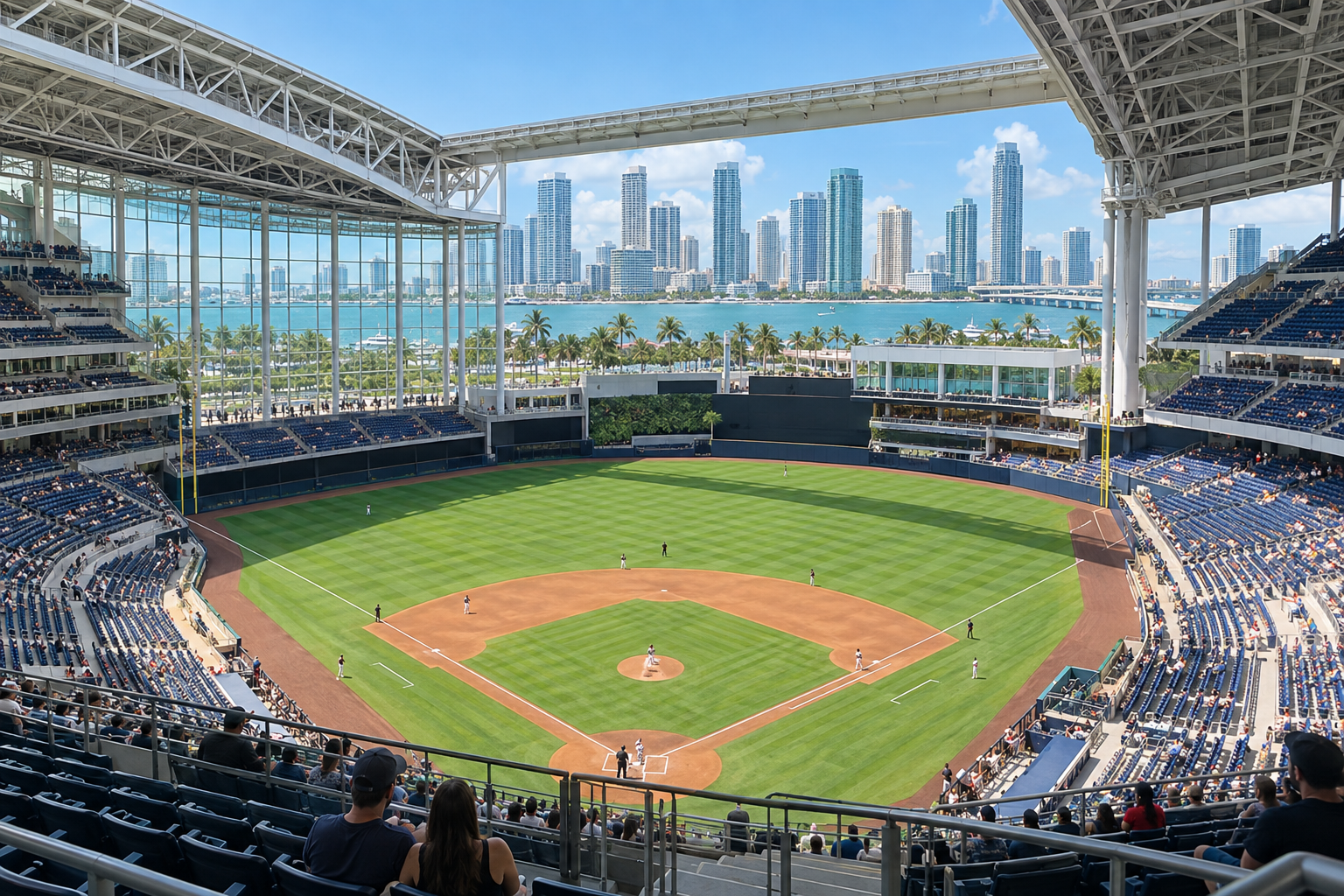
The retractable roof is the headline feature. The team closes it for most games from June through September because of afternoon storms and heat, and the building is fully air-conditioned, which is why we rate this ballpark as the single most comfortable place to watch a sporting event in South Florida in summer. Early-season games in April and the September evening series are the ones most likely to be played open-air, and the team announces the roof status on its site and social channels on game day.
The famous home run sculpture by artist Red Grooms, the neon marlins and flamingos that spun whenever a Marlin went deep, was moved from the outfield to the plaza outside the ballpark in 2019 as part of a renovation that opened up the centre-field view. It still lights up, now as a free public artwork you can photograph without a ticket.
Food leans into Miami. Cuban sandwiches, croquetas and cafecito stands sit alongside standard hot dogs and nachos, with local brewery taps and a bar area in the outfield that has changed names and operators several times. Everything is cashless; card readers and mobile wallets are the only way to pay, and reverse ATMs that convert cash to prepaid cards have been available at some entrances. Outside food rules are strict in most MLB parks and the Marlins list what is permitted in the A to Z fan guide on their site, which is where we confirm bag sizes, water bottle rules and re-entry policy each spring.
Game-day tips
Good to know
Bag rules are enforced at the gates and oversized backpacks get turned away with no storage on site. Resale tickets bought outside the MLB ecosystem frequently turn out to be duplicates or already-transferred barcodes, so stick to the team’s platform.
Gates open about 90 minutes before first pitch for most games, earlier on giveaway nights, and the promotional item usually goes to a fixed number of fans on a first-come basis. Sunday games often include kids running the bases after the final out, a tradition the team has run for years; the eligibility and sign-up rules are posted with the promotional schedule.
Weekday games start in the evening and weekend afternoon games are rare in summer because of heat, so plan for a roughly three-hour game plus 30 to 45 minutes to exit the garages. Dinner before the game on SW 8th Street is the obvious play, and after the game the restaurants and ventanitas of “little havana” stay open later than the ballpark concessions. For a night out afterward, downtown and Brickell are a ten-minute drive east.
The ballpark also hosts non-baseball events worth knowing about as a resident. It staged pool play and the championship game of the World Baseball Classic in 2023, when Japan beat the United States in front of a packed house, and it has drawn concerts, boxing cards and international soccer friendlies in the offseason. Parking and entry rules for those events are set by the promoter, not the team.
From Florida Marlins to Miami Marlins
The name change confuses newcomers and the history explains a lot about how the team operates today. Here is the short version, era by era, with what each one left behind.
| Era | Years | Home ballpark | What happened |
|---|---|---|---|
| Expansion and first title | 1993 to 1997 | Joe Robbie Stadium, Miami Gardens | Wayne Huizenga’s club won the 1997 World Series in its fifth season |
| Fire sale and rebuild | 1998 to 2002 | Pro Player Stadium | Payroll gutted after the title; 108 losses in 1998, John Henry owns briefly |
| Second title | 2003 | Pro Player Stadium | Jeffrey Loria’s team beat the Yankees in six games |
| Long middle | 2004 to 2011 | Dolphin and Sun Life Stadium | Competitive stretches, no playoffs, stadium fight in Miami-Dade |
| Rebrand and move | 2012 to 2017 | Marlins Park, Little Havana | New name, new colours, new ballpark, same losing records |
| Jeter and Sherman era | 2017 to present | loanDepot park | Full rebuild, playoff trips in 2020 and 2023, current youth movement |
The Florida Marlins years in Miami Gardens
For their first 19 seasons the Florida Marlins were tenants of the Dolphins at what is now Hard Rock Stadium in Miami Gardens, a football building with a baseball field squeezed in and outfield seats so far from the plate that the team routinely covered the upper deck. The first game came on April 5, 1993, a win over the Dodgers with 45-year-old knuckleballer Charlie Hough on the mound, and the roster in those early years featured Gary Sheffield, Jeff Conine, who earned the nickname Mr. Marlin, and later a young Edgar Renteria.
The 1997 season remains the franchise’s defining moment. Manager Jim Leyland, who entered the Hall of Fame in 2024, guided a club that reached the postseason as a wild card and won the World Series over Cleveland on Renteria’s single in the 11th inning of Game 7, with Liván Hernández taking Series MVP. Huizenga then sold off most of the roster within months, and the 1998 team lost 108 games, a sequence that still colours how fans here view ownership.
2003 and the Yankees
The second title arrived under Jeffrey Loria with Jack McKeon, 72 years old and pulled out of retirement in May to replace Jeff Torborg, managing a lineup built around Luis Castillo, Iván Rodríguez, Mike Lowell and a 20-year-old Miguel Cabrera. Josh Beckett’s complete-game shutout at Yankee Stadium in Game 6 closed it out, and Dontrelle Willis won Rookie of the Year the same season. Both championships came as wild cards; the Marlins have never won the NL East, a fact worth remembering when the playoff race heats up in September.
The stadium deal and the Miami rename
The move away from Miami Gardens took a decade of politics. Miami-Dade County and the City of Miami financed most of the ballpark through bonds in a deal approved in 2009 that remains controversial locally, and the team agreed to adopt the Miami name as a condition. The Marlins opened the new park in April 2012 with a bright new multicolour look, a large free-agent spending spree that included José Reyes and Mark Buehrle, and then traded most of those players to Toronto in November 2012, just weeks after the first season ended, deepening the trust gap with the community.
The current red-and-blue identity dates to 2019, and the stadium name switched from Marlins Park to loanDepot park in 2021 under a naming-rights agreement. José Fernández, the 2013 Rookie of the Year and the most beloved Marlin of the ballpark era, died in a boating accident in September 2016, and his number 16 has not been worn since.
The rebuild years
Sherman’s group bought the team in 2017, and the new front office traded Giancarlo Stanton, that season’s NL MVP after a 59-homer year, along with Christian Yelich and Marcell Ozuna, to restock the farm system. The results arrived in pieces: a playoff trip in the shortened 2020 season under Don Mattingly, which included a sweep of the Cubs in the wild card round, then an 84-win 2023 season under Schumaker, who won NL Manager of the Year, with Luis Arraez taking the batting title and Kim Ng serving as the first woman to run baseball operations for a major league club.
Ng left after 2023, Bendix arrived from Tampa Bay, and 2024 brought a 100-loss season and trades of Arraez and Jazz Chisholm Jr. as the club reset again. The Rays connection is deliberate: the Marlins now mimic the Tampa Bay model of cheap, controllable players, heavy use of analytics and constant roster churn, which is why the transactions wire moves as fast as it does and why the names below may change by the time you read this.
Players to know right now
Sandy Alcantara is the franchise’s anchor and the 2022 NL Cy Young winner, when he threw six complete games and more than 228 innings with a 2.28 ERA, numbers no one else in baseball approached that year. Tommy John surgery in October 2023 cost him all of 2024, and his return in 2025 was uneven as he rebuilt velocity and command; he remains the pitcher whose starts we circle on the schedule.
Kyle Stowers broke out in 2025 and represented the club at the All-Star Game, giving the lineup a middle-of-the-order left-handed bat, while utility man Javier Sanoja’s work at a half-dozen positions made him a finalist for the utility Gold Glove. Xavier Edwards, Agustín Ramírez behind the plate and Eury Pérez, the hard-throwing young right-hander who also came back from elbow surgery, round out the core that the front office is building around. Dillon Head, the outfielder acquired in the Arraez trade, is the speed threat in the system, and right-hander Owen White’s comeback trail from injury is the kind of low-cost reclamation project this regime favours.
Because the roster changes so often, the team’s official site and the MLB app keep the most reliable player profiles, injury list updates and transactions log; Baseball-Reference holds the historical record and sites like Yahoo Sports and MLB.com post box scores, highlight videos and schedule changes within minutes. We treat any depth chart more than a few weeks old as outdated.
Spring training in Jupiter
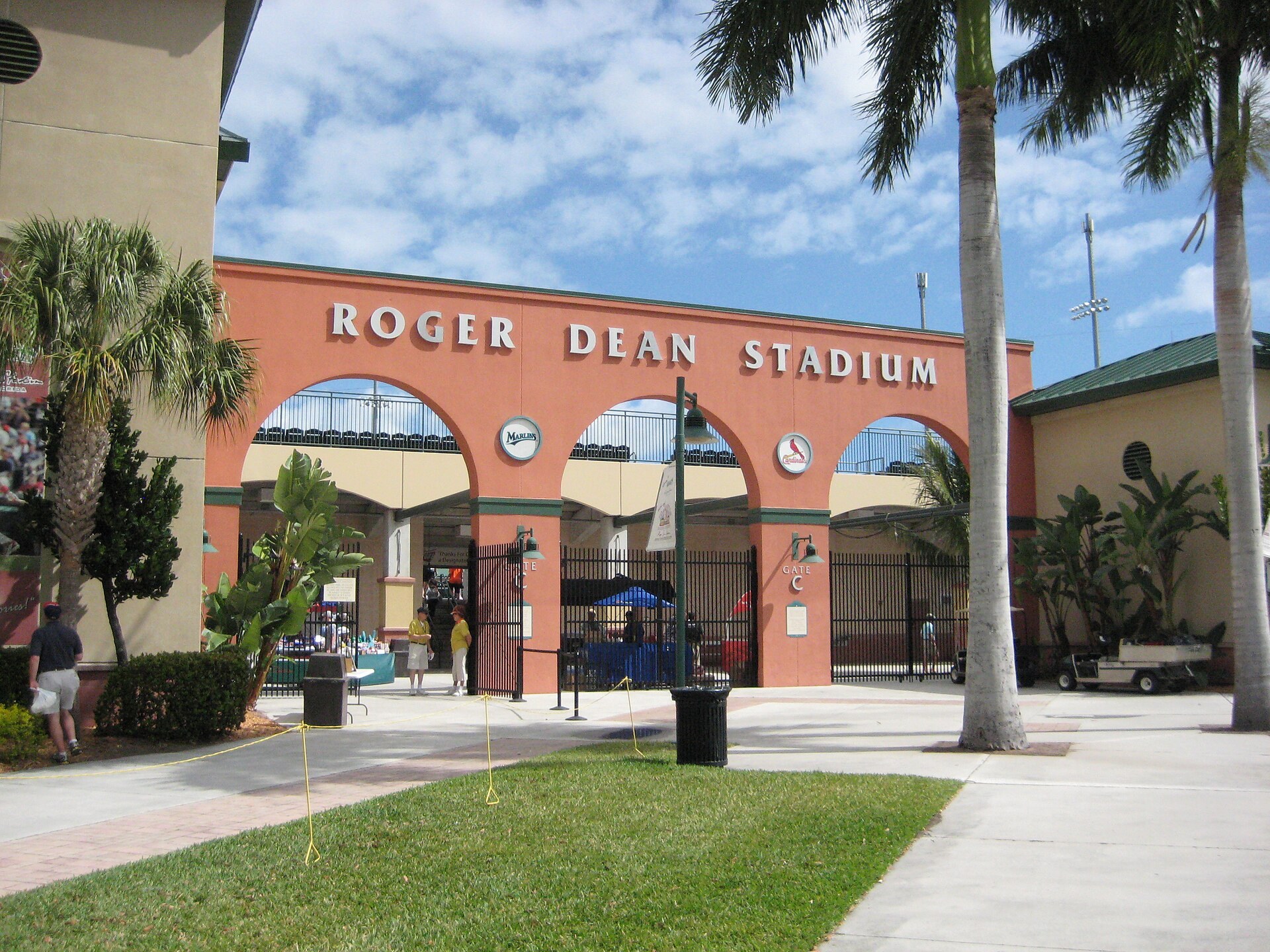
The Marlins hold spring training at Roger Dean Chevrolet Stadium in the Abacoa development in Jupiter, in northern Palm Beach County, a facility they have shared with the St. Louis Cardinals since it opened in 1998. The Grapefruit League schedule runs from late February through late March, with roughly 15 home dates for each club, and the stadium seats under 7,000, so every seat is close and the players walk past fans on the way to the practice fields.
Workouts in the weeks before games start are free to watch from the back fields, and the stadium’s own website posts the schedule, ticket prices and the paid parking arrangement, which fills the surrounding Abacoa lots and streets. From Miami it is about 90 minutes north on I-95 to the Donald Ross Road exit; Brevard and Tri-Rail do not reach Jupiter, so this is a driving trip. The same stadium hosts the Marlins’ Single-A affiliate, the Jupiter Hammerheads, from April through September, which makes it a cheap summer alternative for Palm Beach County families.
The end of spring training overlaps with the “miami open” tennis tournament at Hard Rock Stadium and with Opening Day, which usually falls in the last week of March, so hotels and traffic in the region spike at once.
Following the team beyond the ballpark
Television rights sit with the regional sports network that carries most Florida teams, currently branded as FanDuel Sports Network, with streaming options that have changed almost every season; the team’s site lists the current TV, radio and Spanish-language partners, and we check it each March rather than assume last year’s channel still works. The Marlins also keep a full English and Spanish radio presence, reflecting a fan base that stretches from Hialeah to Homestead.
The minor league chain runs from the Jacksonville Jumbo Shrimp at Triple-A through the Pensacola Blue Wahoos at Double-A and the Beloit Sky Carp at High-A to the Hammerheads in Jupiter, which means a prospect you watch in Palm Beach County in June might be in Little Havana by September. The Marlins also field a strong presence in the Dominican Republic and Venezuela, and the Caribbean flavour of the roster is part of why the club sells so much merchandise in Hialeah and Doral.
Community programmes include youth clinics, a ticket donation programme for schools and nonprofits across Miami-Dade, Broward and Palm Beach, and ballpark tours on non-game days that take groups into the dugout, press box and the Clubhouse level; tour availability and pricing are posted on the team’s site under the ballpark section.
When to get help
Call or message the Marlins ticket office, listed on the team’s official site, for group sales, accessible seating and ticket problems that the app cannot fix. For parking disputes in the city-owned garages, the City of Miami Parking Authority handles complaints, not the team. For spring training questions, contact Roger Dean Chevrolet Stadium directly.
FAQ
Are the Florida Marlins and the Miami Marlins the same team?
Yes. The franchise played as the Florida Marlins from 1993 through 2011 at the Dolphins’ stadium in Miami Gardens, then became the Miami Marlins in 2012 when it moved into its own ballpark in Little Havana. Both World Series titles, 1997 and 2003, belong to the same club.
Where is loanDepot park and what was there before?
The ballpark is at 501 Marlins Way in Little Havana, on the site of the Orange Bowl, which hosted the Dolphins, the Miami Hurricanes and the Orange Bowl game until it was demolished in 2008. The “orange bowl” game itself now takes place at Hard Rock Stadium in Miami Gardens.
How much do Marlins tickets cost?
Upper-deck seats for ordinary weeknight games commonly list below $20 at face value, with premium opponents and promotional nights priced higher and lower-bowl seats behind the plate running well above that. Prices change every season, so check the team’s official ticket page before buying.
Is the roof open or closed?
Closed for most games from June through September because of heat and afternoon storms, and the building is air-conditioned. April and late-September evening games are the most likely to be played with the roof open, and the team posts the roof status on game day.
Can I take Metrorail to a Marlins game?
Not directly. No Metrorail station is within a comfortable walk, so rail riders connect to Metrobus routes along Flagler Street or NW 7th Street, or to the free Miami Trolley’s Little Havana route on game days. Miami-Dade Transit and the City of Miami post current schedules.
Where do the Marlins play spring training?
At Roger Dean Chevrolet Stadium in Jupiter, Palm Beach County, shared with the St. Louis Cardinals, with games from late February through late March. The stadium’s website lists the schedule, ticket prices and parking details.
Have the Marlins ever won their division?
No. Both championships came as wild-card teams, and the club has reached the postseason four times, in 1997, 2003, 2020 and 2023, without ever finishing first in the NL East.