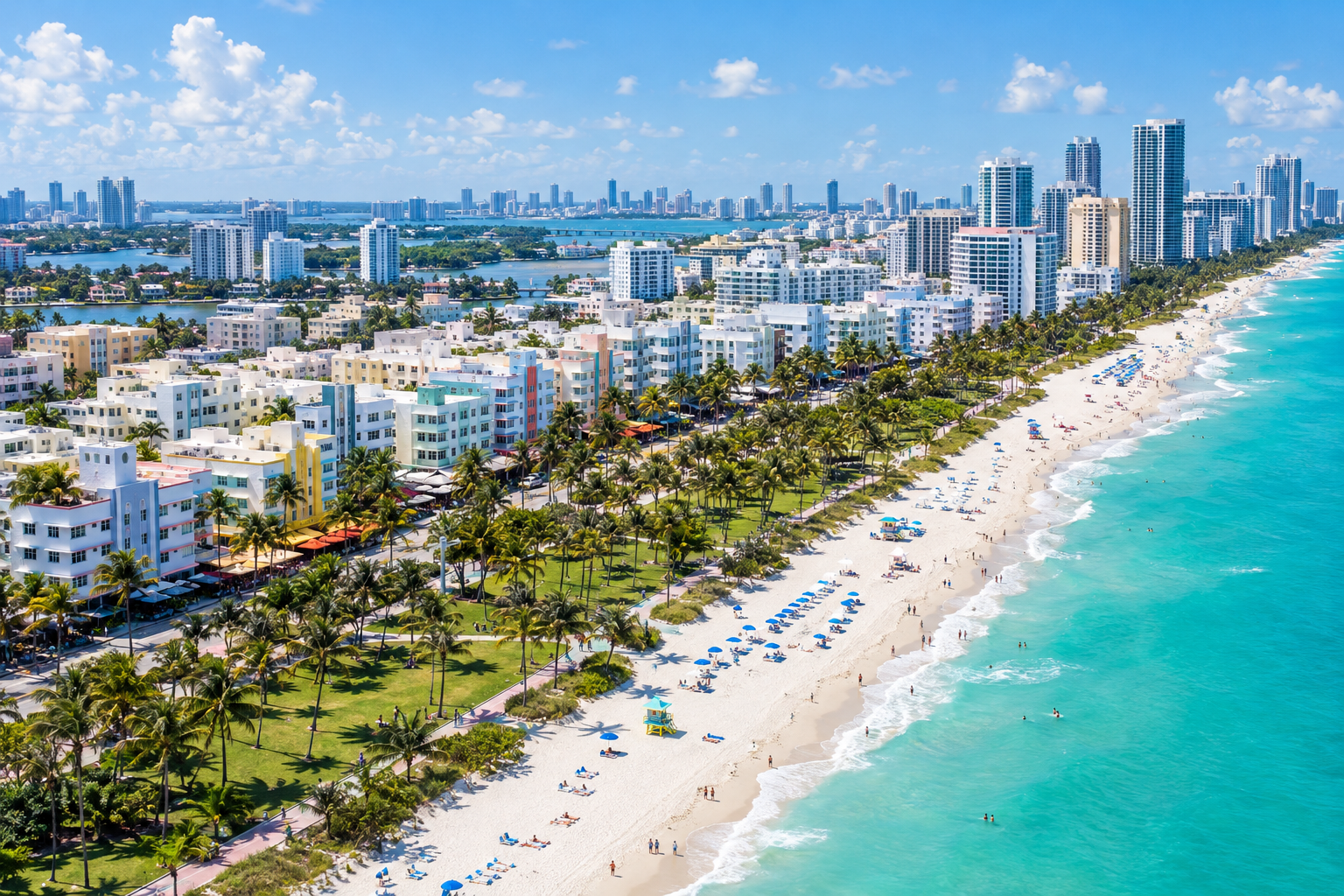
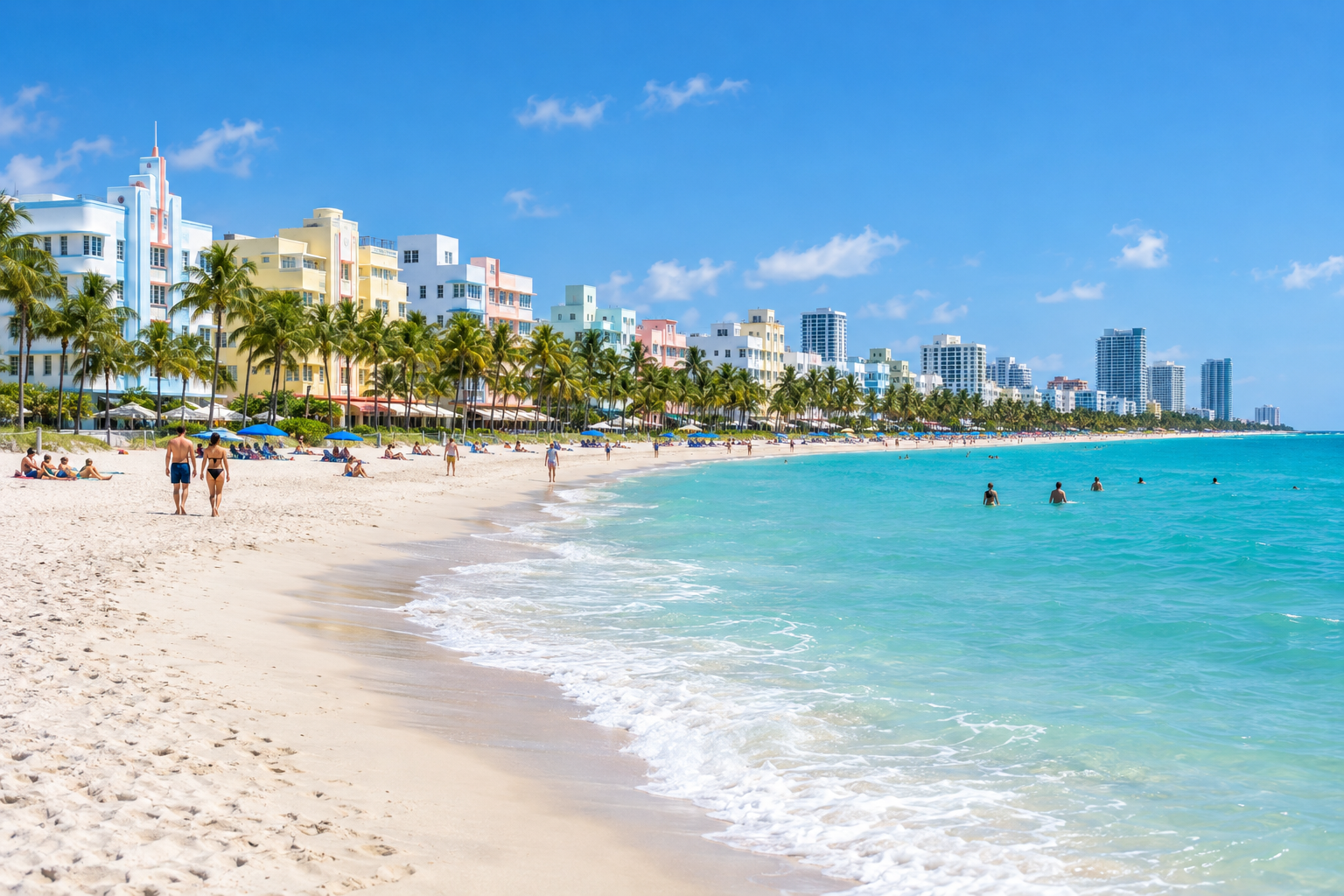
South Beach’s beaches are one continuous strip of public sand. It runs about two miles from South Pointe Park at the southern tip of Miami Beach north to roughly 23rd Street. Pick your stretch by the crowd you want. South Pointe and the blocks south of 5th Street are calmest. Lummus Park (5th to 15th) is the busy postcard scene. The 15th-to-23rd blocks sit between those two.
South Beach at a glance: which stretch fits you
Every block of South Beach shares the same Atlantic water and the same pale, renourished sand. The difference between stretches is the crowd, the backdrop and what sits right behind the dune.
| Stretch | Streets | Crowd level | Best for | Watch out for |
|---|---|---|---|---|
| South Pointe Park | South tip, below 1st St | Moderate | Families, cruise-ship views, the pier | Strong current near the jetty |
| South of Fifth (SoFi) | 1st to 5th St | Low to moderate | Quiet swims, locals, early walks | Fewer vendors and restrooms |
| Lummus Park | 5th to 15th St | High | Classic Art Deco scene, volleyball, Muscle Beach | Crowds, noise, rental hustle |
| 12th Street Beach | Around 12th St | High | LGBTQ+ friendly beach scene | Busy weekends |
| Lincoln Road blocks | 14th to 17th St | Moderate to high | Easy access from Lincoln Road and hotels | Hotel chair zones |
| Collins Park area | 17th to 23rd St | Moderate | Museum-plus-beach days, calmer sand | Construction and hotel traffic |
Lifeguard towers are spread along the whole strip, so you’re covered wherever you land during staffed hours. The famous pastel towers make easy meeting points. Tell your group “the purple tower at 10th” and nobody gets lost.
Plan your visit
- Check the flag forecast and weather before you leave.
- Choose your stretch by crowd level using the table above.
- Park in a city garage or take the trolley or bus.
- Enter at a numbered street access path, not over the dunes.
- Set up within sight of a staffed lifeguard tower.
- Swim between morning and late afternoon, when towers are staffed.
- Leave before sunset rush, or walk to South Pointe to watch it.
What to bring
- Reef-safe sunscreen, SPF 30 or higher
- Refillable water bottle (no glass)
- Umbrella or a plan to rent one
- Water shoes for the pier rocks and hot sand
- Small bag with ID, card and phone in a waterproof pouch
- A cover-up and sandals for walking Ocean Drive afterward
The six stretches of South Beach, south to north
1. South Pointe Park and the pier
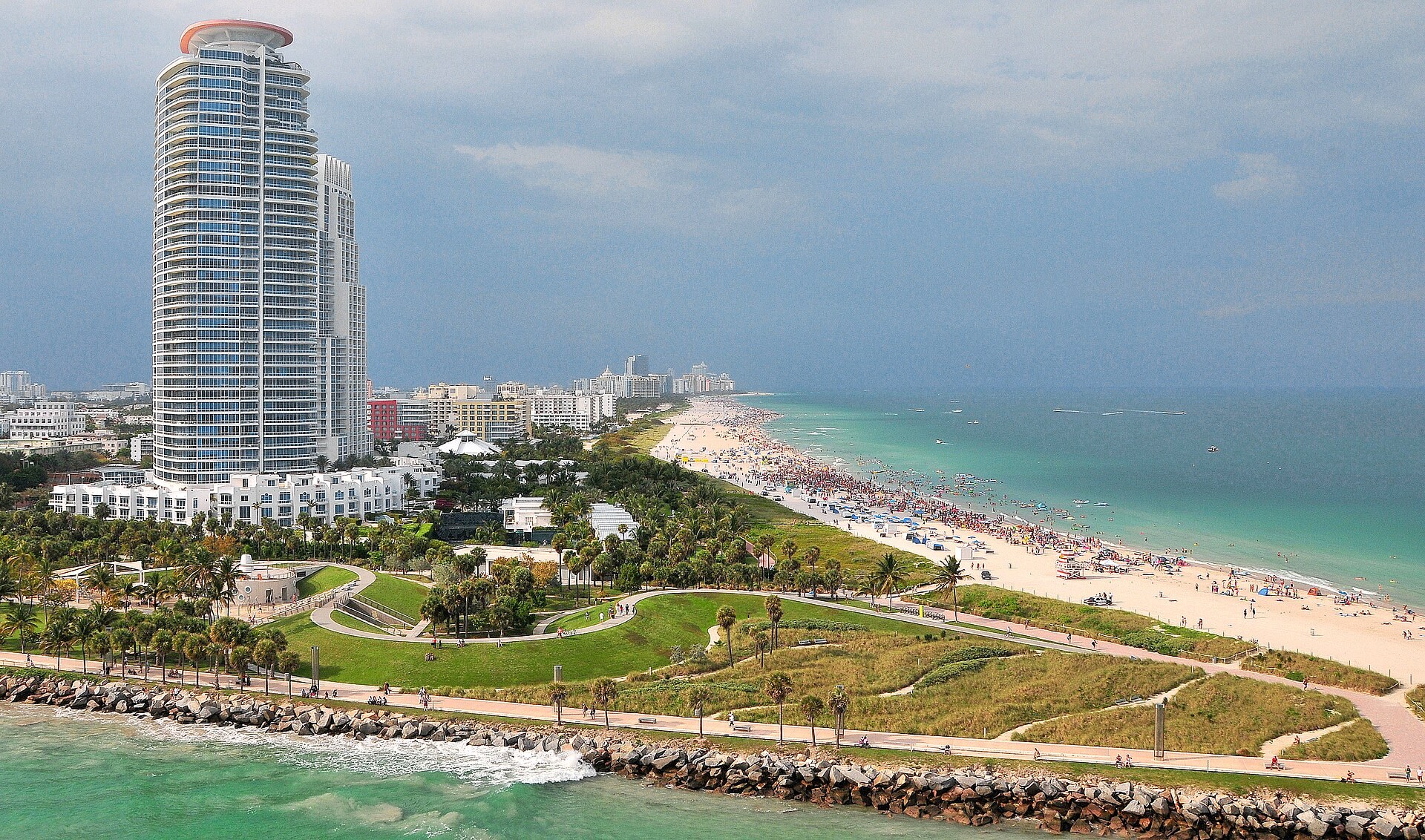
South Pointe Park fills the southern tip of Miami Beach, where the island meets Government Cut. Government Cut is the shipping channel into PortMiami. That gives you something no other South Beach stretch offers: cruise ships and cargo vessels sliding past close enough to wave at. Late afternoon departures are a local ritual.
The park has wide lawns, shaded paths, a playground and a splash pad. That makes it the easiest South Beach stop for families with small kids. South Pointe Pier juts out past the jetty and is popular for fishing, slow walks and photos. The pier sometimes closes for weather or repairs, so check the City of Miami Beach parks page if it’s your main reason to come.
The beach just north of the park is sheltered and usually calmer than Lummus Park. Stay away from the jetty itself, though. Currents near the rocks and the channel are strong, and swimming there is a bad idea even on flat days.
There’s a paid parking lot inside the park, which fills early on weekends. Restrooms and outdoor showers are available. Smith & Wollensky sits at the water’s edge if you want a sit-down meal with a channel view.
Local tip
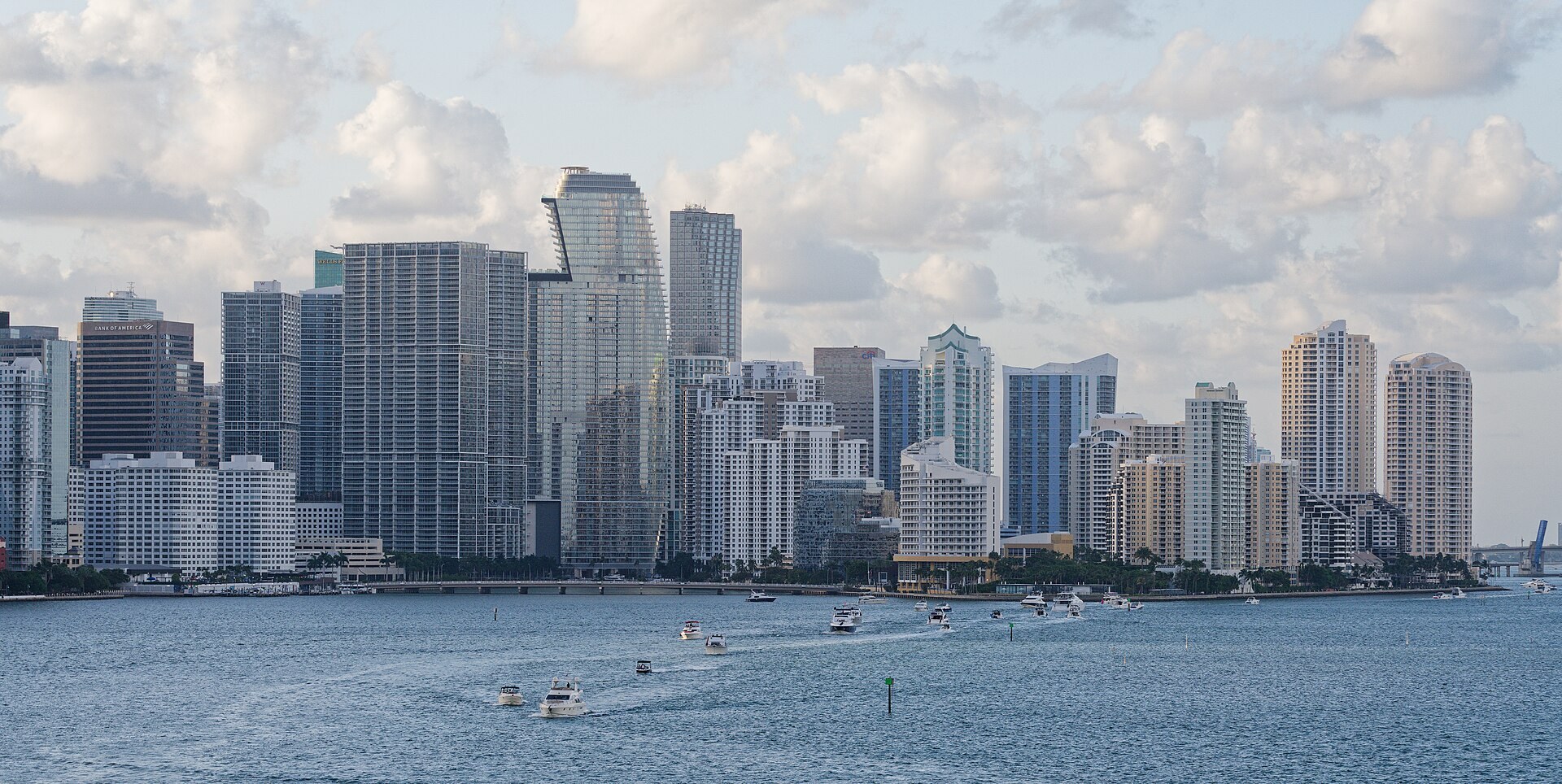
For sunset on a beach that faces east, walk to the end of South Pointe Park or the pier. You’ll get the sky over Biscayne Bay and the Miami skyline to the west, with ships passing in the foreground.
2. South of Fifth (1st to 5th Street)
Locals call the blocks south of 5th Street “SoFi.” Behind the beach it’s mostly condo towers and residential streets rather than nightclubs. The result is the quietest regular stretch of South Beach. You’ll see joggers, dog walkers on the beachwalk (dogs stay off the sand), retirees and families who live nearby.
Come here if you want to swim, read and actually hear the waves. There are fewer chair-rental stands, so bring your own setup. The paved beachwalk starts here and runs north, which makes SoFi a natural starting point for a sunrise walk or bike ride.
Food options behind the beach lean toward upscale. Joe’s Stone Crab is a few blocks inland at Washington Avenue and 1st Street, and stone crab season generally runs mid-October through mid-May. Grab a casual lunch on Washington Avenue or Collins Avenue instead if you’re on a budget.
3. Lummus Park (5th to 15th Street)
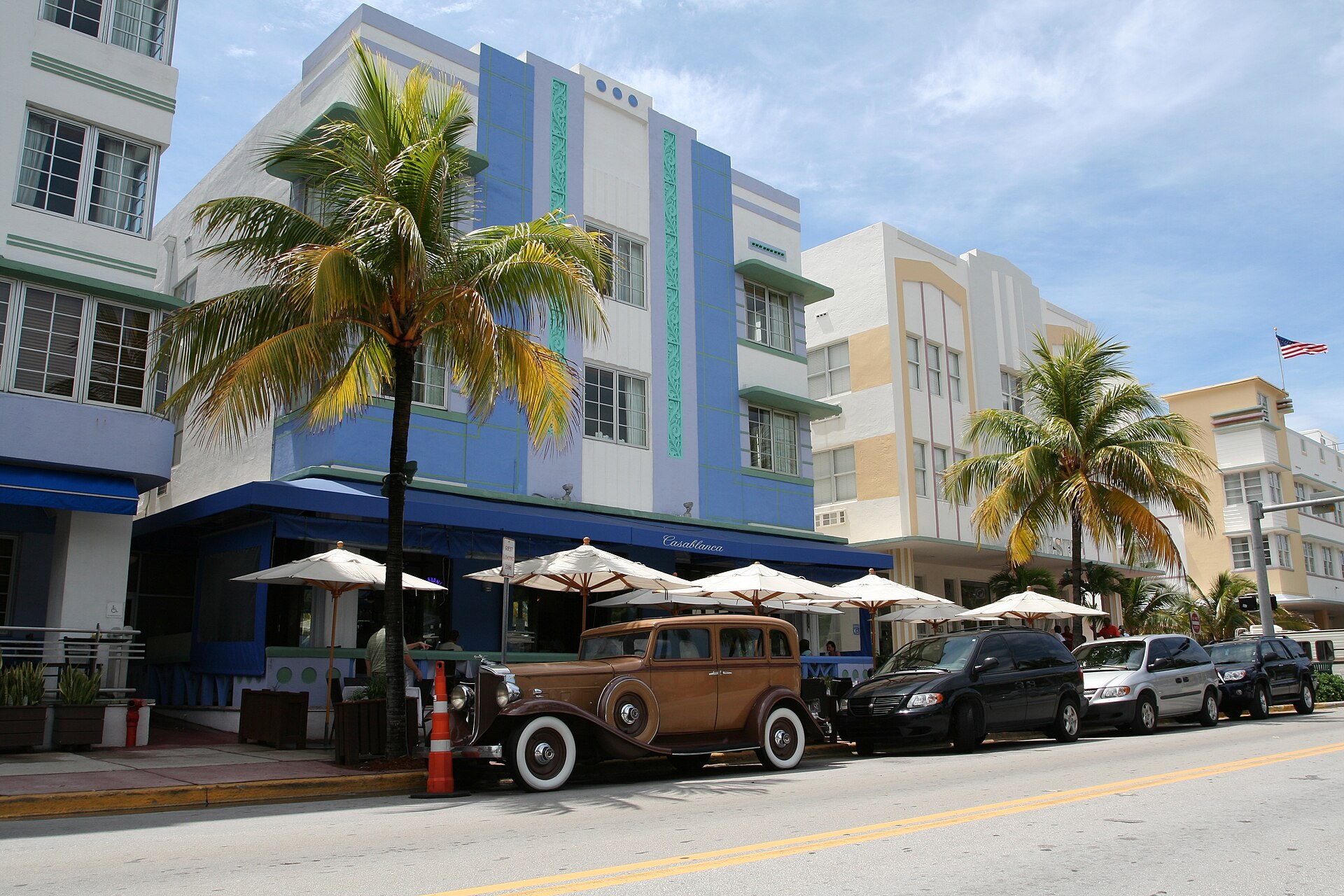
This is the South Beach people picture. Lummus Park runs between Ocean Drive and the sand from about 5th Street to 15th Street. It puts the pastel Art Deco hotels, the palm-lined promenade and the wide, busy beach all in one frame. If it’s your first visit and you want the full experience, this is it.
The park strip between Ocean Drive and the dune has walking paths, playgrounds, public restrooms and outdoor showers. Muscle Beach, an outdoor gym, sits around 9th Street. Volleyball nets dot the sand, and pickup games happen most afternoons.
Lummus Park is also the most crowded and the most commercial stretch. Expect chair-and-umbrella vendors, music, photo shoots and a steady stream of visitors. On holiday weekends and during March it gets packed.
Good to know
Rental chairs and umbrellas in Lummus Park are priced per day and not cheap. Confirm the total, including any “service” add-on, before you sit down. Some vendors start setting up a rental in front of you and charge once you’re settled.
The Art Deco Historic District right behind the beach is worth an hour on foot. The Art Deco Welcome Center on Ocean Drive at 10th Street runs walking tours. Check the Miami Design Preservation League for current tour times and prices. Our South Beach guide to Miami Beach’s most famous neighborhood covers the streets behind the sand in more detail.
4. 12th Street Beach
The beach around 12th Street has long been South Beach’s best-known LGBTQ+ gathering spot. The rainbow flag on the lifeguard tower marks it. It’s welcoming to everyone, with a social, upbeat crowd that peaks on weekends and during Miami Beach Pride in spring.
It shares Lummus Park’s amenities: restrooms, showers and food on Ocean Drive steps away. Parking is the same squeeze as the rest of Lummus Park. Use the 7th Street or 13th Street city garages rather than circling for a meter.
5. The Lincoln Road blocks (14th to 17th Street)
North of 14th Street, Ocean Drive ends and Collins Avenue hotels take over the beachfront. Many of these hotels put out their own loungers and umbrellas for guests. The public sand in front of them stays open to everyone. Florida beaches below the mean high-water line are public, and Miami Beach’s beachfront is broadly accessible from the street-end paths.
This stretch is handy if you’re spending the day on Lincoln Road, the pedestrian shopping street that ends near the beach. It’s also a short walk from the 16th Street and 17th Street garages. The crowd is a mix of hotel guests and day-trippers, and noticeably less hectic than Lummus Park.
6. Collins Park and the 21st Street area (17th to 23rd Street)
The northern end of South Beach is anchored by Collins Park. It’s a green space near 21st Street with the Bass Museum of Art and the Miami Beach Regional Library right behind it. This is the best stretch for a mixed day: museum in the morning, beach after lunch.
The beach here is wide and usually calmer than the middle of South Beach. Big resort hotels line it, and you’ll find a few beachfront bars and restaurants attached to them. The Miami Beach Botanical Garden and the convention center are a short walk west.
Around 23rd Street, South Beach gives way to Mid-Beach. The sand keeps going without a break, so you can walk north as far as your legs allow.
How to choose by trip type
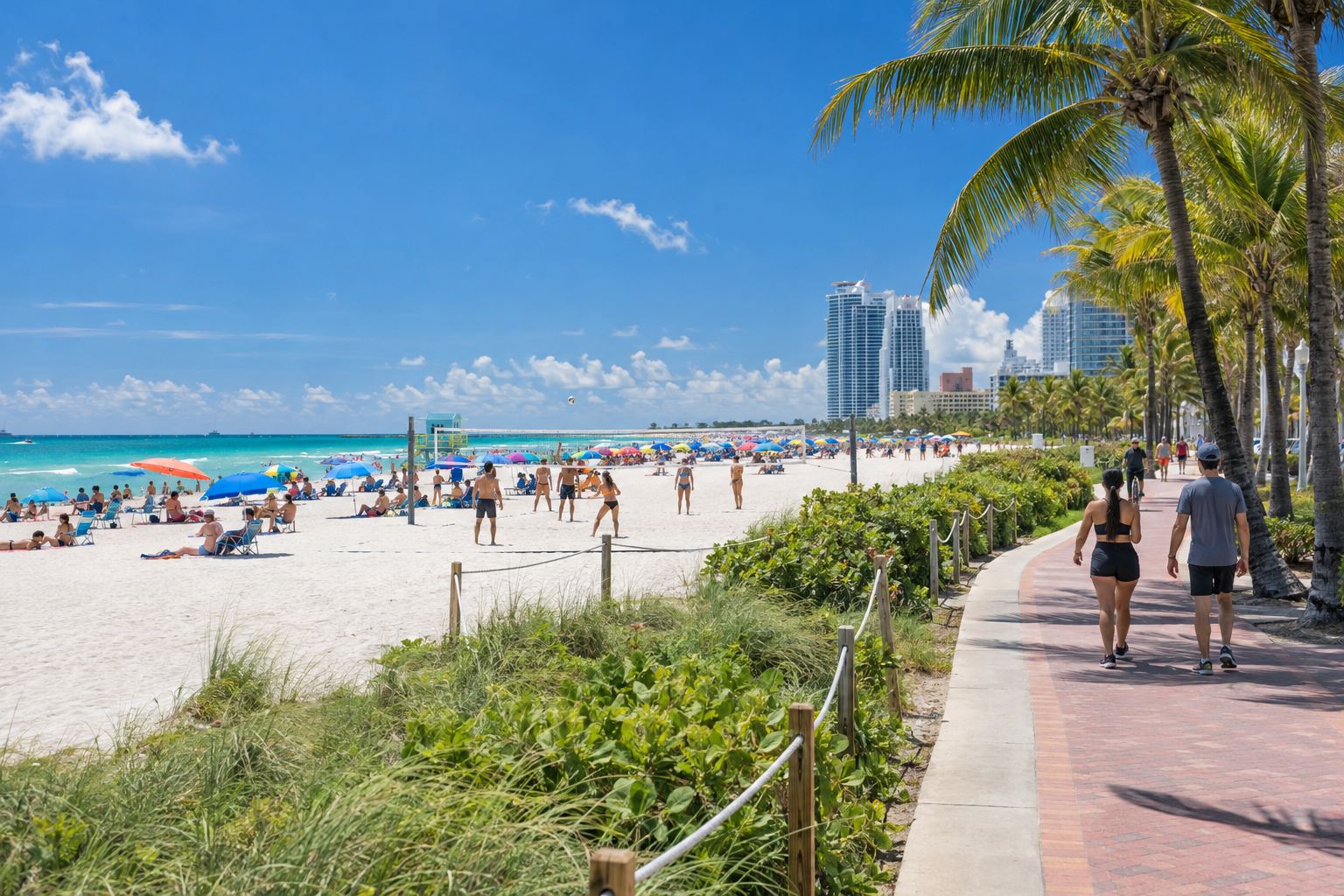
First-timers: Lummus Park between 8th and 12th Street. You get the Art Deco backdrop, food and restrooms close by, and plenty of lifeguard towers.
Families with young kids: South Pointe Park. The playground, splash pad, lawns and calmer water make long days easier. SoFi is a close second.
Quiet swimmers and readers: South of Fifth on a weekday morning, or the 20s near Collins Park.
Groups and social days: Lummus Park for volleyball and music, or 12th Street for its party-friendly crowd.
Photographers: Sunrise anywhere along Lummus Park, when the towers glow and the sand is empty. Late afternoon at South Pointe works too, for ships and skyline.
Visitors without a car: The Collins Park and Lincoln Road blocks. Both are close to bus stops and the free trolley.
Getting there and parking
Quick steps: parking near South Beach
- Decide your stretch first, then pick the closest garage.
- Use a city garage for long beach days.
- Pay for street meters by app or at the pay station.
- Read the zone signs; resident-only blocks are strictly enforced.
- Note your garage level and nearest street before walking to the sand.
Garages and lots
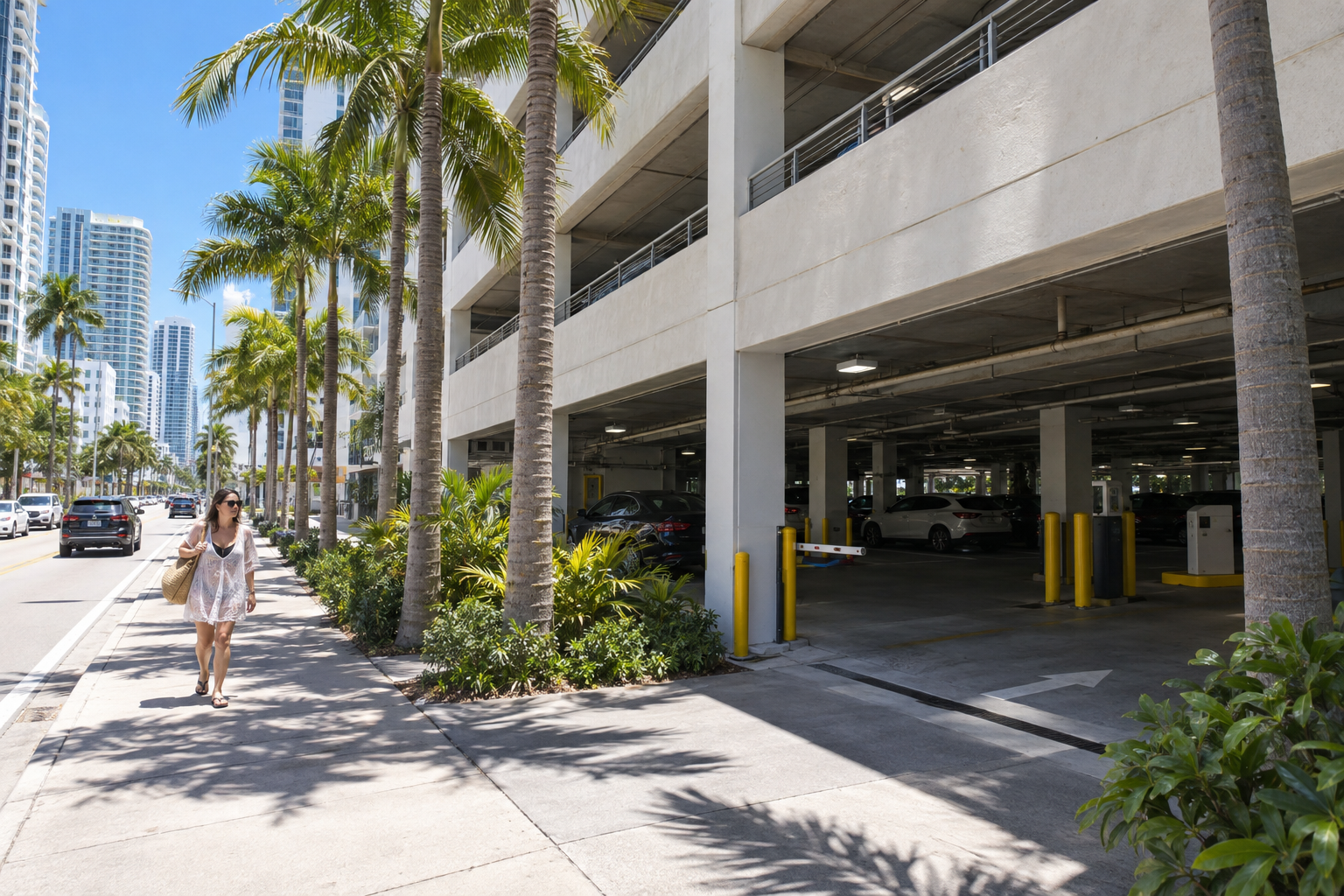
The City of Miami Beach runs several municipal garages close to the beach. These are usually the least stressful option for a full day:
- 7th Street Garage at Collins Avenue: best for southern Lummus Park
- 13th Street Garage at Collins Avenue: best for central Lummus Park and 12th Street
- 16th and 17th Street garages: best for the Lincoln Road blocks and Collins Park
- South Pointe Park lot: best for the park and pier, fills early
Rates in South Beach are higher than elsewhere in the city and change by season and event. Confirm current rates on the City of Miami Beach parking department pages. During special events and in March, the city has charged flat event rates and closed some lots. Check announcements before you drive over.
Good to know
Towing in South Beach is fast and expensive. Never park in a private lot “just for a minute,” and read residential zone signs carefully. A towed car can eat most of a beach day plus a large fee.
Bus, trolley and ride options
Miami Beach runs a free trolley system with loops through South Beach, including a South Beach loop that passes near the beach. Miami-Dade Transit’s Metrobus also serves Collins Avenue and the causeways. Route 120 Beach MAX connects the beach with downtown Miami.
Routes and schedules change, so use the Miami-Dade Transit trip planner or the city’s trolley page on the day you travel. The city has also run Freebee, an on-demand electric shuttle, in parts of Miami Beach. Check whether it currently covers your area.
Biking is easy on the flat beachwalk. The beachwalk runs north from South Pointe through South Beach and well into Mid-Beach, though some sections are shared with pedestrians. Ride slowly in crowded areas.
Rules, safety and the beach flags
Flags and lifeguards
Miami Beach Ocean Rescue staffs the lifeguard towers during daytime hours, with longer coverage in the summer months. Confirm current tower hours on the City of Miami Beach Ocean Rescue page. Outside staffed hours, you’re swimming without a guard.
Learn the flag system before you go in:
- Green: low hazard, calm conditions
- Yellow: medium hazard, moderate surf or currents
- Red: high hazard, strong surf or currents
- Double red: water closed to the public
- Purple: dangerous marine life, often jellyfish or Portuguese man o’ war
Rip currents are the biggest real risk on South Beach. If you’re caught in one, don’t fight it head-on. Swim parallel to the shore until you’re out of the pull, then angle back in. If you can’t, float, wave and yell for help.
When to get help
If someone is struggling in the water, alert the nearest lifeguard immediately and call 911. Don’t swim out yourself unless you’re trained. For a sting, a cut or heat illness, go to the closest staffed tower; lifeguards carry first aid and can call for medical support.
What’s allowed and what isn’t
- Alcohol and glass: Both are banned on Miami Beach’s beaches. Expect a citation, and bag checks during busy periods.
- Dogs: Not allowed on South Beach sand. See the dog-friendly options further down.
- Dunes: Stay on the marked access paths. The dunes protect the beach and the buildings behind it, and walking on them can bring a fine.
- Smoking: The city has restricted smoking on its beaches. Follow posted signs.
- Nudity: Topless sunbathing is common on South Beach. Full nudity is only legal on Haulover’s designated clothing-optional section farther north.
- Spring break: In March, the city has added curfews, flat parking rates, bag checks and restricted beach entry points. Check the City of Miami Beach site before planning a March beach day.
Water quality, seaweed and stingers
The Florida Department of Health in Miami-Dade samples beach water for bacteria through the Florida Healthy Beaches Program. It posts advisories when levels are high, which can happen after heavy rain. Check the latest results online before you swim, especially in rainy season.
Sargassum seaweed can wash ashore in large mats in late spring and summer. The city clears it with heavy equipment, but heavy days still smell and make the shallows murky. Portuguese man o’ war show up mostly on windy days with onshore breezes, often in winter and spring. A purple flag is your cue to look closely before you wade in.
Accessibility
Miami Beach has offered beach wheelchairs and access mats at selected beach entrances. Availability and locations change. Contact Miami Beach Ocean Rescue ahead of your visit to confirm which entrances have mats and how to reserve a beach wheelchair.
Best time to go
By season
Winter and early spring (December to April) is high season. The air is dry and mild and the skies are clear, but the water can feel cool in January and February. Hotel prices and crowds peak, especially around Art Basel Miami Beach in early December and through March.
Late spring (May to early June) is the sweet spot for many locals. The water warms up, crowds thin out and prices start to drop before the summer rain sets in.
Summer (June to September) brings bathtub-warm water and flat, clear swimming days. It also brings strong sun, daily afternoon thunderstorms and the possibility of sargassum. Swim in the morning and head inside when you hear thunder. Lightning over the beach is serious, and lifeguards will clear the water.
Fall (October to November) is quieter and cheaper, with warm water. It overlaps with the tail end of hurricane season, which runs June 1 through November 30. Watch the National Hurricane Center forecasts if you’re booking far ahead.
By time of day
Arrive before 10 a.m. for easy parking, cooler sand and calm water. Midday is crowded and the sun is harsh, so plan a lunch break in the shade. Late afternoon brings softer light and thinner crowds. The beach faces east, so sunrise is the big show. Sunset is better from the bay side or South Pointe.
Local tip
On weekends, locals often skip Lummus Park and park at South Pointe before 9 a.m. They walk north along the beachwalk, swim near the 3rd Street towers and leave before the noon rush.
Beyond South Beach: nearby beaches worth the drive
South Beach is only the start of Miami-Dade’s coastline. If you want more space, calmer water or a dog-friendly day, these are the beaches locals drive to. For our full rankings, see our guide to the best Miami beaches, ranked by locals.
Mid-Beach and North Beach
From roughly the low 20s up to about 63rd Street, Mid-Beach is lined with resort hotels, including the Faena at 32nd Street and the Fontainebleau at 44th Street. A long boardwalk-style beachwalk runs along it. The beach is just as wide as South Beach and generally less crowded.
North Beach, roughly 63rd to 87th Streets, feels more residential and relaxed. North Beach Oceanside Park, in the upper 70s and 80s, has shaded picnic spots and walking paths. Parking up here is usually easier and cheaper than in South Beach.
Surfside, Bal Harbour and Sunny Isles Beach
North of Miami Beach, Surfside is a small town with a quiet, family-oriented beach and limited commercial activity. Bal Harbour is mostly luxury hotels and condos, with a beachfront path called the Bal Harbour Beach Walk.
Sunny Isles Beach, farther north, has high-rise towers and the Newport Fishing Pier. It’s a good choice for long, uncrowded walks. Parking and beach access rules differ by town, so check each municipality’s website.
Haulover Beach
Haulover sits between Bal Harbour and Sunny Isles on A1A, in a Miami-Dade County park. It’s known for wide sand and kite-flying fields. Its north end has Florida’s best-known legal clothing-optional beach. The park also has a marina and an inlet popular with boaters.
There’s paid parking. The clothing-optional and regular sections are clearly marked. Our guide to Haulover Beach and Haulover Park explains the sections, parking and rules.
Key Biscayne and Virginia Key
Cross the Rickenbacker Causeway and the beach mood changes completely. Crandon Park on Key Biscayne is a Miami-Dade County park with calm, shallow water protected by an offshore sandbar. It also has picnic areas and family facilities, and it’s one of the best beaches in the county for young kids.
Bill Baggs Cape Florida State Park, at the southern tip of Key Biscayne, has the Cape Florida Lighthouse, quieter beaches and trails. Florida State Parks charges a vehicle entry fee; check the park’s official page for current rates.
Historic Virginia Key Beach Park opened in 1945 as the “colored-only” beach during segregation. Today it’s a public park with picnic areas and a museum project dedicated to its history. It’s a meaningful stop as well as a pleasant beach.
The Rickenbacker Causeway has a toll. Check the current rate and payment method with Miami-Dade County before you go.
Matheson Hammock Park
In Coral Gables, Matheson Hammock Park has an unusual man-made atoll pool on Biscayne Bay, flushed naturally by the tides. The water is shallow and calm, with no surf. That makes it a favorite with families and anyone nervous about ocean waves. The surrounding hammock has trails, and there’s a restaurant in a historic coral-rock building.
Miami-Dade Parks charges a vehicle entry fee here. Confirm the amount on the county parks site.
Dog-friendly beaches
Dogs aren’t allowed on South Beach. Miami-Dade has a few designated options:
- Haulover Park Dog Beach: a dedicated off-leash section of Haulover Park, open on set days. Check Miami-Dade Parks for the schedule.
- Miami Beach dog beach: the city has operated a designated dog beach in North Beach on a limited schedule. Confirm the current location, days and permit rules on the City of Miami Beach website.
- Hobie Island Beach Park: near the Rickenbacker Causeway, a popular spot where locals bring dogs. Rules can change, so check posted signs.
Bring water, waste bags and proof of vaccinations, and keep dogs leashed until you’re inside the designated area.
Farther afield in South Florida
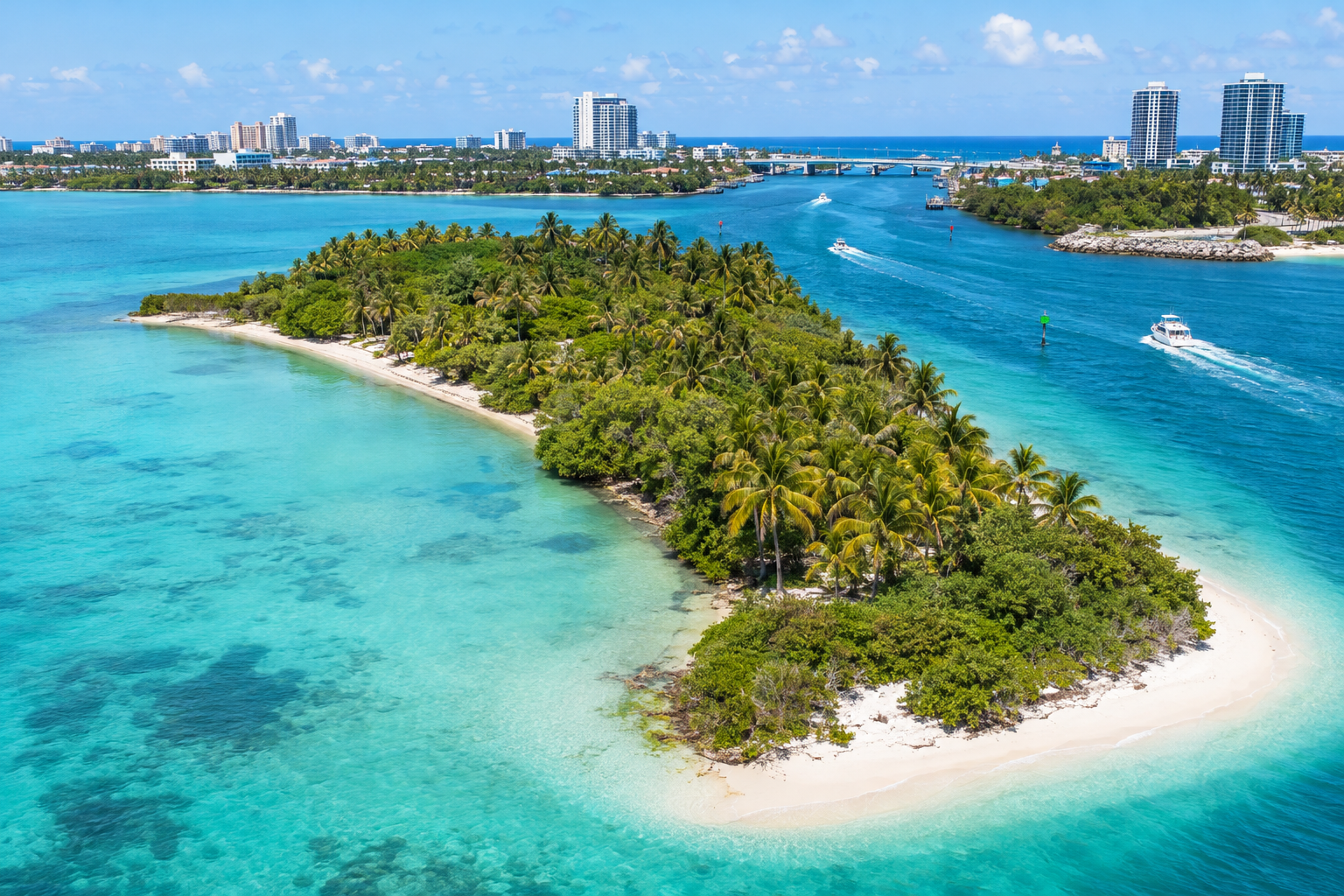
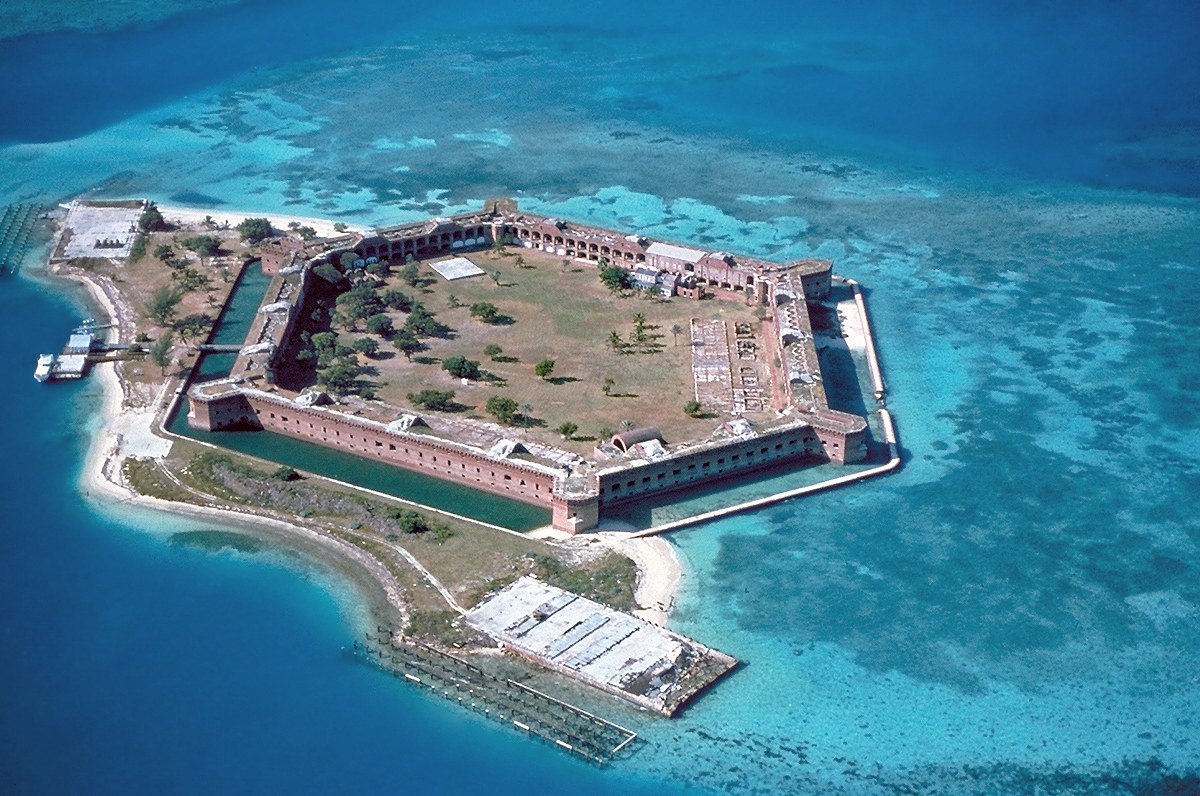
If you’re building a longer trip, Broward and Palm Beach counties have their own standout beaches. Peanut Island in Palm Beach is a great snorkeling day, reached by water taxi or private boat. Nature lovers can pair a beach morning with a trip into Everglades National Park from Miami. If you’re heading south to the Keys, plan ahead for getting to Dry Tortugas National Park. Ferry and seaplane seats sell out.
Where to stay near the best stretches
Pick your base by the stretch you’ll use most:
- South of Fifth: quieter boutique hotels and condo rentals, short walks to South Pointe Park
- Ocean Drive and Lummus Park: historic Art Deco hotels with nightlife outside the door and some noise
- Collins Avenue, 14th to 23rd Street: larger resort hotels with pools, beach service and calmer evenings
- Mid-Beach: big resorts and more space, a short ride from the South Beach scene
Many hotels charge a nightly resort fee and separate parking fees. Check the final price before you book. If you’re staying near Lummus Park on a weekend, ask for a room facing away from Ocean Drive.
FAQ
Are South Beach beaches free?
Yes. All of South Beach’s sand is public and free to use. You’ll pay for parking, chair and umbrella rentals, and food, but there’s no entry fee for the beach itself. South Pointe Park is also free to enter, with paid parking in its lot.
Which part of South Beach is best for swimming?
South Pointe (away from the jetty) and the stretch south of 5th Street usually have the calmest water and the fewest crowds. Wherever you swim, stay near a staffed lifeguard tower and check the flag first.
Is South Miami Beach the same as South Beach?
People often say “South Miami Beach” when they mean South Beach, the southern end of the city of Miami Beach. South Miami is a separate inland city with no beach. If you’re looking for sand, you want South Beach in Miami Beach.
Can you drink alcohol on South Beach?
No. Alcohol and glass containers are banned on Miami Beach’s beaches. Police enforcement increases during spring break and holiday weekends, and bag checks are common in March.
Are there restrooms and showers on South Beach?
Yes. Public restrooms and outdoor showers are spread along Lummus Park and available at South Pointe Park. The quieter blocks have fewer facilities, so plan breaks around the nearest ones.
Can I bring my dog to South Beach?
No, dogs aren’t allowed on South Beach sand. They can walk on the beachwalk on a leash. For a beach day with your dog, use Haulover Park Dog Beach or the City of Miami Beach’s designated dog beach in North Beach. Check current days and rules first.
When are lifeguards on duty?
Miami Beach Ocean Rescue staffs towers during daytime hours, with extended hours in summer. Confirm the current schedule on the City of Miami Beach Ocean Rescue page before you plan an early or late swim.
What’s the easiest way to get to South Beach without a car?
Take Miami-Dade Metrobus, including Route 120 Beach MAX from downtown Miami. Once you’re on Miami Beach, use the city’s free trolley loops. Check the transit trip planner the day you travel, since routes and schedules change.