
Haiti TPS (Temporary Protected Status) is a federal humanitarian program. It lets eligible Haitian nationals already in the United States live and work here legally while conditions in Haiti make return unsafe. The government has tried to end it, and federal courts have repeatedly stepped in, so your current status depends on the latest court order and Federal Register notice, not on headlines.
Quick steps: check your Haiti TPS status
- Find your latest I-797 approval notice and work permit (EAD).
- Read the Haiti page in the TPS section of uscis.gov.
- Check the newest Federal Register notice for Haiti.
- Look up your case with your receipt number in USCIS Case Status Online.
- Update your address with USCIS (Form AR-11) within 10 days of any move.
- Get screened by a nonprofit legal provider for other immigration options.
- Keep copies of every notice, card and receipt.
What you need
- Your USCIS receipt number(s) from Form I-797
- Your current Employment Authorization Document (EAD)
- Haitian passport or national ID and proof of identity
- Proof of residence in the U.S. (leases, bills, pay stubs)
- Copies of any court or police records, if you have them
What temporary protected status means

TPS is a status the Secretary of Homeland Security can grant to a country when armed conflict, environmental disaster or other extraordinary conditions prevent people from returning safely. It is temporary by design. It runs in blocks of 6, 12 or 18 months, and DHS must decide before each block ends whether to extend it or terminate it.
With TPS you get three main protections:
- Protection from deportation while the designation is in effect
- Employment authorization, through a work permit (EAD)
- Possible travel authorization, if you apply and are approved before leaving
TPS is not a green card and it is not citizenship. It does not by itself put you on a path to permanent residence. When a designation ends, you return to whatever status you held before, or to no status at all, unless you have something else in place.
How Haiti TPS got here: key dates
Haiti’s designation has been through more legal fights than almost any other country’s. This timeline uses dates from DHS notices and published court rulings.
| Date | What happened |
|---|---|
| January 2010 | Haiti first designated for TPS after the January 12 earthquake |
| 2011 to 2017 | Haiti redesignated in 2011, then extended several times |
| November 2017 | DHS announced termination, effective July 22, 2019 |
| 2018 to 2021 | Federal courts (including Ramos v. Nielsen and Saget v. Trump) blocked the termination; DHS auto-extended documents |
| August 3, 2021 | New Haiti designation took effect (announced May 2021) |
| February 4, 2023 | Extension and redesignation began, running to August 3, 2024 |
| August 4, 2024 | Extension and redesignation began, set to run to February 3, 2026 |
| February 2025 | DHS cut the end date short, to August 3, 2025 |
| July 1, 2025 | A federal judge in Brooklyn ruled the cut unlawful, restoring February 3, 2026 |
| November 2025 | DHS published a termination of Haiti TPS effective February 3, 2026 |
| February 2026 | A federal judge in Washington, D.C. paused the termination; the government appealed |
That last line is the one that matters most and the one most likely to change. The Supreme Court twice allowed the termination of Venezuela’s TPS to take effect in 2025 while litigation continued. That shows how fast a lower-court order can be overridden. Treat any article, including this one, as a starting point. The official source is the Haiti page on uscis.gov and the most recent Haiti notice in the Federal Register.
Good to know
Social media posts and WhatsApp forwards about “TPS ending tomorrow” are often wrong or out of date. Check the USCIS Haiti page before you quit a job, sell property or leave the country.
Who qualifies for Haitian TPS

Eligibility depends on which designation you registered under. The 2024 redesignation set the most recent dates.
| Requirement | Under the 2024 redesignation |
|---|---|
| Nationality | Haitian national, or a person with no nationality who last habitually lived in Haiti |
| Continuous residence in U.S. | Since June 3, 2024 |
| Continuous physical presence in U.S. | Since August 4, 2024 |
| Filing | During the registration or re-registration window DHS announced |
| Criminal bars | Ineligible with one felony or two or more misdemeanors in the U.S. |
| Other bars | Persecution of others, terrorism-related and certain security grounds |
If you arrived after June 3, 2024, you do not meet the residence date for the current designation. A new redesignation would be needed for you to qualify. Under the November 2025 termination notice, DHS is not accepting new initial applications as part of an open designation. Late initial filing is allowed only in narrow cases, such as when you held another status during the registration window. Ask a legal provider whether you fit.
Forms, documents and fees
These are the core USCIS forms tied to Haiti TPS.
| Form | What it is for | Who files it |
|---|---|---|
| I-821 | Application for Temporary Protected Status (initial or re-registration) | Every TPS applicant |
| I-765 | Application for Employment Authorization | Anyone who wants a work permit |
| I-131 | Travel authorization before leaving the U.S. | TPS holders who need to travel |
| AR-11 | Change of address | Anyone who moves, within 10 days |
| I-797 | Receipt or approval notice (issued by USCIS) | You receive it; keep every one |
Fees changed under the April 2024 USCIS fee rule and again under the 2025 federal budget law, which added new TPS-related charges. Do not rely on an old number from a friend’s filing. Use the USCIS Fee Calculator or the fee schedule (Form G-1055) on uscis.gov on the day you file. Fee waivers through Form I-912 are available for some TPS filings, but not all.
Local tip
Filing online through a USCIS account usually gets you a receipt faster than paper, and you can see notices in your account. If you file by mail, use tracked delivery and keep the tracking slip with your copies.
Work authorization, E-Verify and Florida employers
Your work permit is often the document people panic about first. When DHS extends Haiti TPS, or when a court order keeps it alive, it usually publishes a Federal Register notice that automatically extends certain EADs. Your card may show a past date and still be valid.
What to show an employer when your card looks expired:
- Your EAD with category A12 or C19
- A copy of the Federal Register notice that extends it, or a USCIS page confirming the extension
- Your I-797 notice, if you have a pending renewal
About E-Verify in Florida
Florida law (SB 1718, in effect since July 1, 2023) requires private employers with 25 or more employees to use E-Verify for new hires. Public employers must use it too. This affects many Haitian TPS workers in South Florida’s hospitals, nursing homes, hotels, airports and construction sites.
For employers, the rules are specific:
- Reverify on Form I-9 only when the work authorization actually expires, including any automatic extension
- Do not demand a specific document; the worker chooses from the I-9 list
- Do not fire someone just because a card date has passed if a valid auto-extension applies
- Treating Haitian workers differently based on national origin can violate federal anti-discrimination law
If an employer gets this wrong, the Immigrant and Employee Rights Section of the U.S. Department of Justice handles complaints about I-9 and E-Verify discrimination.
Travel, driver’s licenses and other practical issues
Travel. Do not leave the U.S. without approved travel authorization (Form I-131). Leaving without it can end your TPS. Even with it, re-entry is not guaranteed, and a pending termination makes travel riskier. Talk to a lawyer before booking a flight to Port-au-Prince or Cap-Haïtien.
Driver’s licenses. Florida ties a non-citizen’s license to documented lawful presence. Your license generally expires when your authorized stay or EAD does. Bring your EAD, I-797 and any Federal Register extension notice to a Florida Highway Safety and Motor Vehicles (FLHSMV) service center or county tax collector office. Check the FLHSMV site for the current document list before you go.
Benefits and taxes. TPS holders can get a Social Security number for work and must file taxes. Eligibility for public benefits is limited and varies by program, so ask a benefits navigator before applying.
Can Haiti TPS lead to a green card?
Not on its own. In Sanchez v. Mayorkas (2021), the Supreme Court ruled unanimously that TPS alone does not satisfy the “admission” requirement for adjusting to permanent residence. If you entered without inspection, TPS does not fix that.
Some TPS holders still have a path through another route:
- Marriage to a U.S. citizen, if you were inspected and admitted or paroled when you entered
- Employer sponsorship, in limited cases
- Asylum, if you filed or can still file and meet the standard
- Other humanitarian options, such as U visas for crime victims or Special Immigrant Juvenile Status for young people
Parole programs many Haitians used, including the Haitian Family Reunification Parole program and the CHNV parole process, were ended in 2025. If your entry depended on one of them, get a legal screening now. Do not wait until your TPS end date.
Common problems and what to do
| Problem | What usually works |
|---|---|
| EAD shows an expired date | Check for an automatic extension notice; show it with your card |
| Employer says you can’t work | Show the extension notice; contact DOJ’s Immigrant and Employee Rights Section if refused |
| Lost I-797 or EAD | File a replacement on Form I-765; request records with a FOIA request |
| Moved and missed USCIS mail | File AR-11 online and update your address on any pending case |
| Re-registration window missed | Ask a lawyer about filing late with “good cause” |
| Someone offers to “guarantee” a green card | Walk away; report it to the Florida Attorney General |
Good to know
In Florida, a notary public is not a lawyer and cannot give immigration advice. “Notario” fraud targets Haitian and Latin American families every time TPS is in the news. Only licensed attorneys and DOJ-accredited representatives can legally help with your case.
Where to get help in South Florida
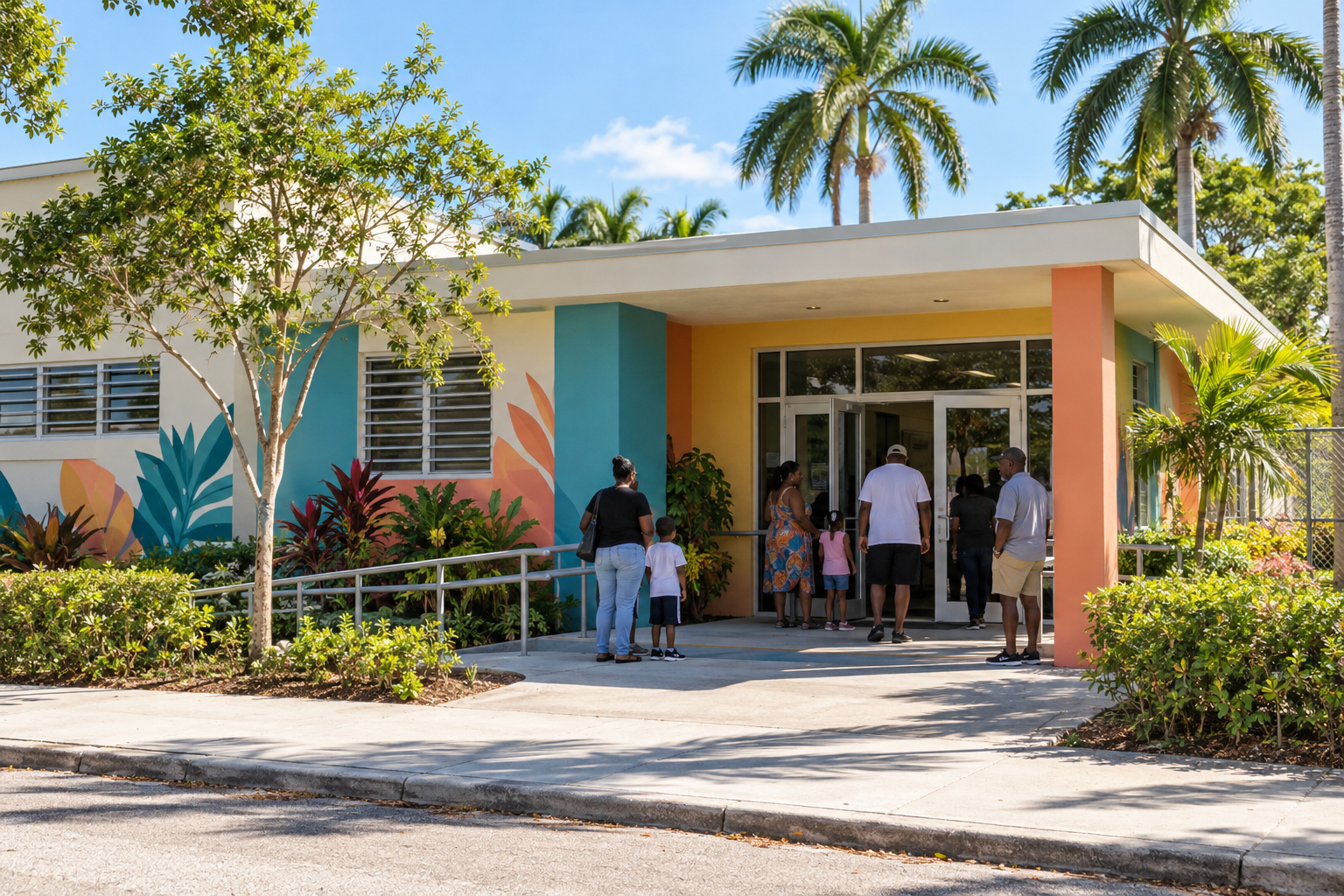
Florida has the largest Haitian community in the country, concentrated in Miami-Dade, Broward and Palm Beach. Many groups here help in Haitian Creole. Call ahead to confirm services and intake hours, because these change with funding and caseloads.
| Organization | Area | What they do |
|---|---|---|
| Family Action Network Movement (FANM) | Little Haiti, Miami | Community organizing, TPS updates, referrals |
| Sant La Haitian Neighborhood Center | North Miami | Case management, benefits navigation |
| Americans for Immigrant Justice | Miami | Free legal services for immigrants |
| Catholic Legal Services, Archdiocese of Miami | Miami-Dade and Broward | Low-cost immigration legal help |
| Florida Immigrant Coalition (FLIC) | Statewide, Miami-based | Know-your-rights info and community alerts |
| Haitian Lawyers Association | Miami | Bar association; attorney referrals |
| Catholic Charities, Diocese of Palm Beach | Palm Beach County | Immigration legal services |
If you live near FANM’s office, our Little Haiti Miami neighborhood guide covers the area, parking and nearby community spots. National groups also track Haitian TPS news and court action. These include Haitian Bridge Alliance, the Haiti Immigration Project, Haitian Women for Haitian Refugees (Brooklyn), Haitian Americans United for Progress (Queens) and HIAS.
For a full list of legitimate low-cost providers, the Department of Justice publishes a roster of recognized organizations and accredited representatives by state. The American Immigration Lawyers Association has a lawyer search with a South Florida chapter.
When to get help
See a licensed immigration attorney or accredited representative if you have any arrest record, a past removal order, a pending asylum case, or plans to travel. Do the same if your TPS is your only status. The USCIS Contact Center (800-375-5283) can answer case questions but cannot give legal advice.
How to follow TPS Haiti news without getting misled
Use this order of trust:
- Official: USCIS Haiti TPS page, Federal Register notices, DHS press releases and the court orders themselves
- Proven reporting: the Miami Herald, WLRN and national outlets that cite court filings directly
- Community alerts: FANM, FLIC and local legal providers, who usually explain what a ruling means in plain language
- Unverified: social media posts and voice notes with no source
A DHS announcement is not final until it appears in the Federal Register. A court ruling can be paused on appeal within days. When news breaks, wait for the USCIS page to update before changing anything in your life.
FAQ
Is Haiti TPS ending?
DHS published a termination notice in the Federal Register on November 28, 2025, with the termination set to take effect February 3, 2026. A federal judge in Washington, D.C. paused it in February 2026, and the government appealed. Check the Haiti page on uscis.gov for the current status, because appeals courts or the Supreme Court can change it quickly.
Can I still work with Haitian TPS?
Yes, as long as the designation remains in effect and your EAD is valid or automatically extended. If your card shows a past date, look for the Federal Register notice extending it and show that to your employer.
Can I still apply for Haiti TPS for the first time?
Generally no, unless DHS announces a new designation or you qualify for late initial filing. Late filing is limited to specific cases, such as holding another status during the registration period. A legal provider can tell you if you qualify.
Can I travel to Haiti on TPS?
Only with approved travel authorization filed on Form I-131 before you leave. Even then, re-entry is not guaranteed, especially while termination is being litigated. Get legal advice first.
Does TPS lead to a green card?
Not by itself. After Sanchez v. Mayorkas, TPS does not count as an admission for adjustment of status. You may still qualify through a U.S. citizen spouse, an employer, asylum or another route.
What happens to my status if TPS ends?
You return to whatever status you had before TPS, if any. If you had none, you could face removal unless you have another application pending or another form of relief. Get screened now so you know your options before any end date.