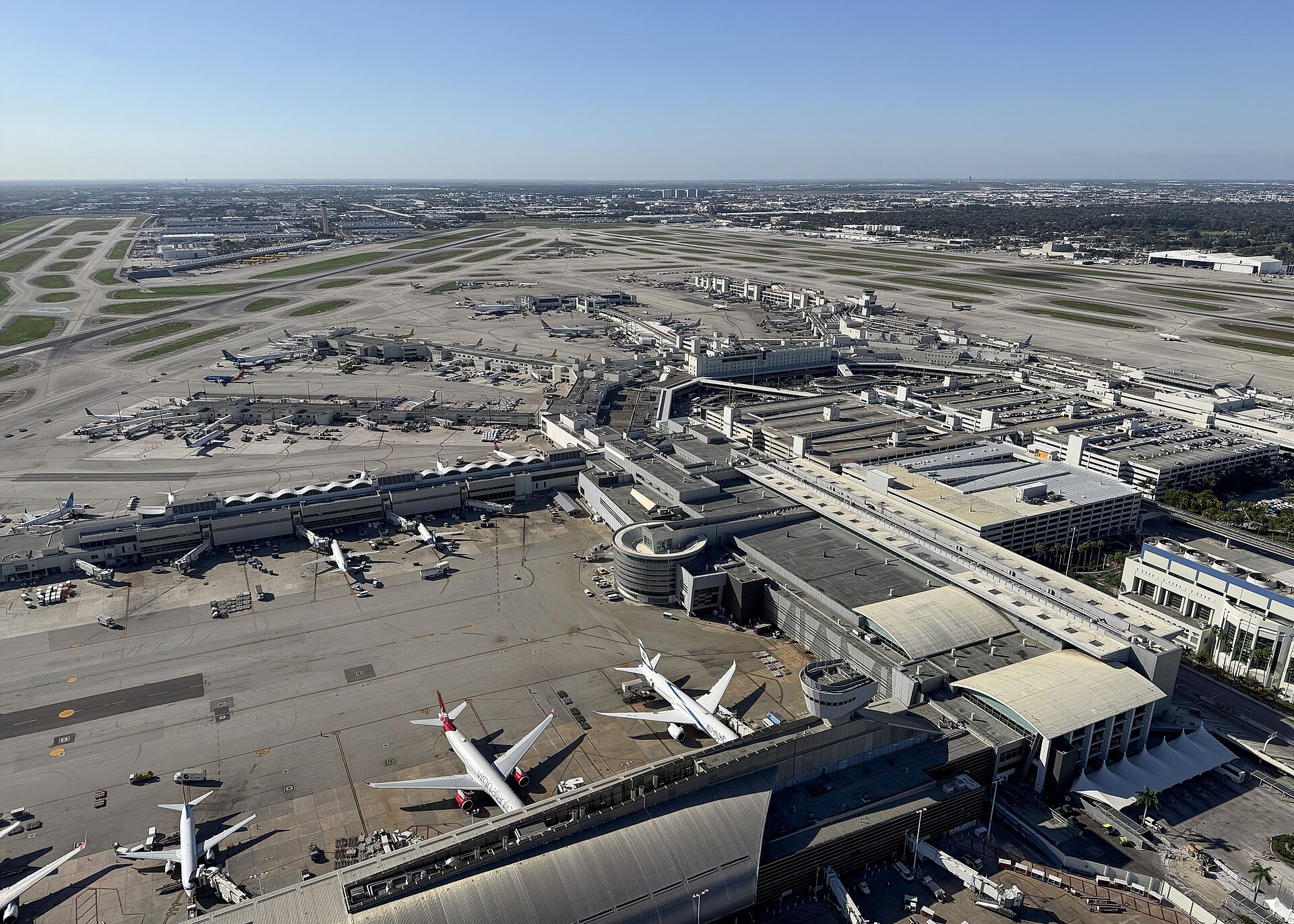
Miami International Airport (MIA) sits about 8 miles northwest of downtown at 2100 NW 42nd Avenue, with three connected terminals, two parking garages and a free people mover to the rental car center and rail station. This guide covers which concourse your airline uses, where to park, how to reach the beach or the cruise port, and where to confirm fees and hours before you go.
Plan your visit
Plan your visit
- Check your concourse letter on the airport’s airline list the night before.
- Pick your transport: garage, Economy Park & Ride, Metrorail, taxi or rideshare.
- Arrive 2 hours before domestic flights, 3 hours before international.
- Enter at the departures (upper) level nearest your concourse.
- Clear security at a checkpoint for your concourse; PreCheck lanes are marked.
- In Concourse D, use the Skytrain if your gate is in the far sections.
- On return, follow signs to the MIA Mover for rentals and trains, or to the garages.
What to bring
What you need
- Government photo ID, or passport for international flights
- Airline app with your boarding pass and gate alerts
- Credit or debit card (garage exits are automated)
- Phone charger; outlets are plentiful in D and J, patchier in E and F
- Light layer for the air conditioning, which runs cold year-round
Getting there and parking
MIA sits where the Dolphin Expressway (SR 836), Le Jeune Road (NW 42nd Avenue) and SR 112 meet. From downtown Miami the drive takes 15 to 25 minutes outside rush hour. From Fort Lauderdale on I-95 or the Turnpike, plan 40 to 60 minutes, more on Friday afternoons.
The roadway splits into an upper departures level and a lower arrivals level. Both levels loop past all three terminals, so if you miss your drop-off point you simply continue around.
Parking options
| Option | Location | Best for | Where to confirm rates |
|---|---|---|---|
| Dolphin Garage | Opposite North and Central terminals | Short trips, American Airlines flyers | MIA parking page |
| Flamingo Garage | Opposite Central and South terminals | Delta, Concourse H and J flyers | MIA parking page |
| Valet | Departures level curbside | Late arrivals, heavy luggage | MIA parking page |
| Economy Park & Ride | Off-terminal lot with shuttle | Trips of 3+ days | MIA parking page |
| Cell phone waiting lot | Signposted on the entry roads | Waiting for an arriving passenger | Free |
The Dolphin and Flamingo garages connect directly to the terminals by third-level walkways, so you never have to cross the roadway. Rates change periodically and the airport posts the current daily and hourly amounts on its parking page. Treat any price you see on a third-party site as out of date.
Economy Park & Ride is the cheapest option the airport itself runs. A shuttle loops between the lot and the terminals, and you should add 20 to 30 minutes to your timeline for the bus and the walk. Both garages fill during Thanksgiving week, Christmas and the spring break and cruise peaks from February through April.
Local tip
Off-airport lots along NW 36th Street and the Blue Lagoon area often undercut the garages for stays of a week or more. Compare them against the airport’s Economy lot, and book ahead for holiday weeks.
MIA Mover, rental cars and rail
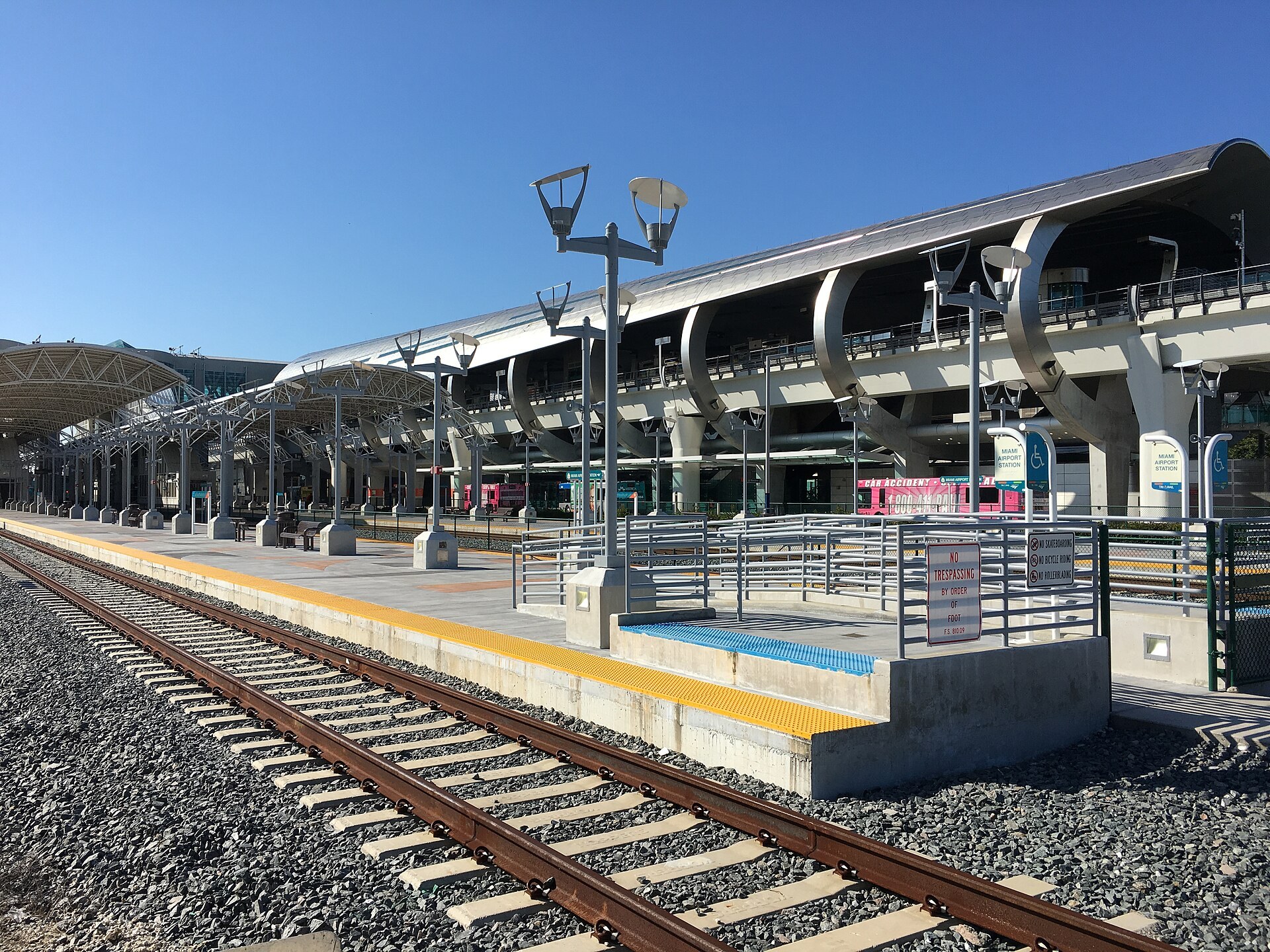
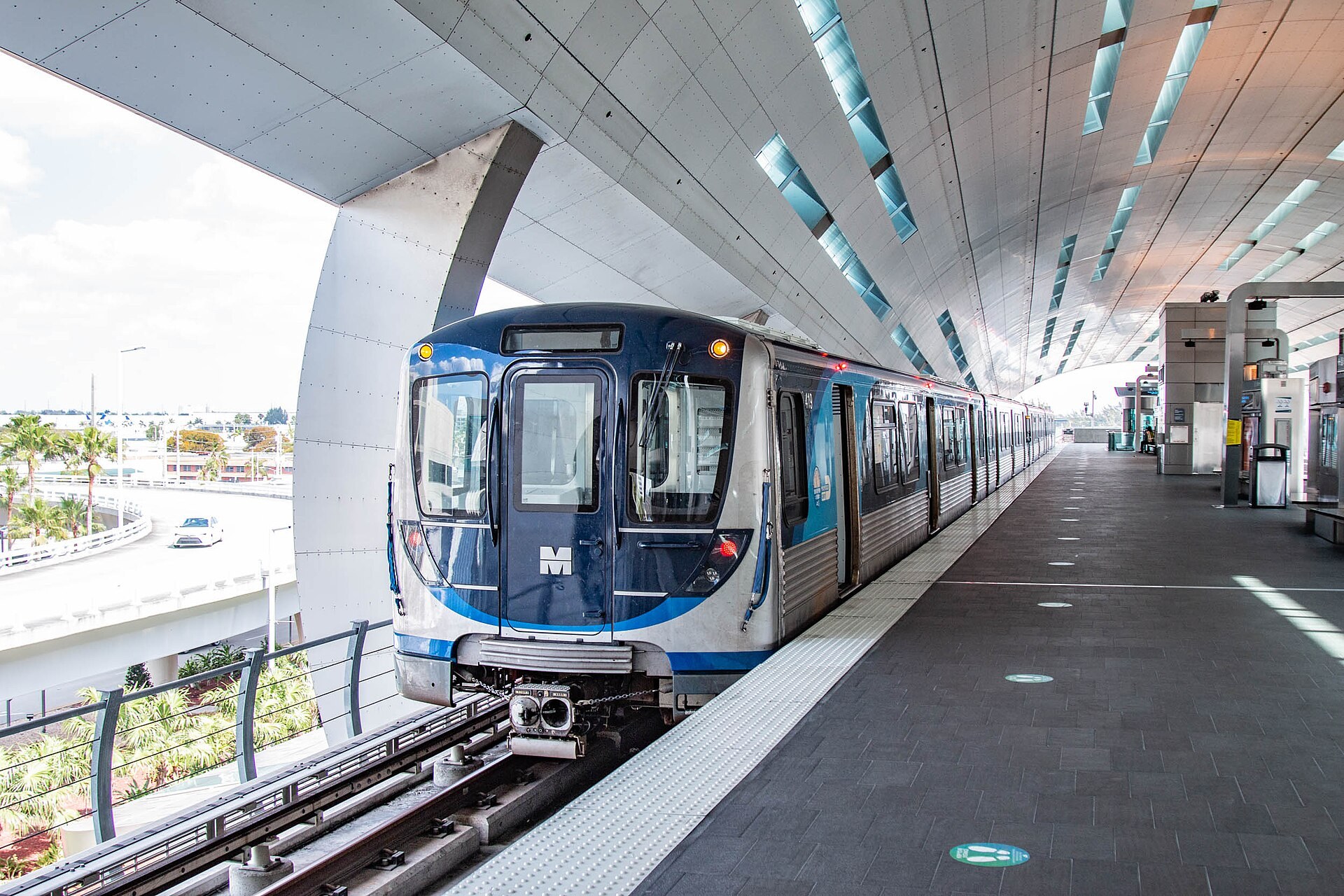
The MIA Mover is a free automated train that runs from the third level of the Central Terminal to the Miami Intermodal Center (MIC) in about 5 minutes. The MIC houses the consolidated Rental Car Center, where every major rental brand operates from one building, plus Miami Airport Station for Metrorail, Tri-Rail and Metrobus.
You reach the Mover station by following the overhead signs through the Dolphin Garage walkway or from the Central Terminal. If you land at Concourse D or J, allow 10 to 15 minutes of walking to reach it.
Public transport from the airport
| Service | Where it goes | Fare | Travel time | Confirm at |
|---|---|---|---|---|
| Metrorail Orange Line | Downtown (Government Center), Brickell, Dadeland | $2.25 standard fare | About 15 min to downtown | Miami-Dade Transit |
| Tri-Rail | Hialeah, Fort Lauderdale, Boca Raton, West Palm Beach | Zone-based | 1 to 2 hours northbound | Tri-Rail site |
| Metrobus 150 Airport Flyer | Miami Beach via Mid-Beach and South Beach | Standard Metrobus fare | 35 to 50 min | Miami-Dade Transit |
| Local Metrobus routes | Hialeah, Doral, Coral Gables and more | $2.25 standard fare | Varies | Miami-Dade Transit |
Metrorail is the best value into downtown and Brickell. Trains run every few minutes at peak and every 15 or so late at night, and the Orange Line connects at Government Center to the Metromover, a free downtown loop. Pay with an EASY Card, a contactless bank card or the transit app at the gates. The standard fare has been $2.25 for years, but confirm it on the Miami-Dade Transit site before you rely on it.
For Brightline to Fort Lauderdale, West Palm Beach or Orlando, take Metrorail to Government Center and walk about 5 minutes to MiamiCentral. Brightline does not stop at the airport.
Taxis and rideshare
Taxis wait at marked stands on the arrivals level outside every terminal. Miami-Dade County sets flat fares from the airport to Miami Beach south of 63rd Street and to the Port of Miami, and the current amounts are posted at the stand and on the county’s taxi page. Everywhere else runs on the meter.
Uber and Lyft pick up at designated rideshare zones on the arrivals level. Your app shows the exact pillar number once you request the ride. Pickups are slow during the Saturday and Sunday cruise turnover, when thousands of passengers land within a few hours.
Good to know
Ignore anyone inside the terminal offering a ride or a “discount taxi”. Licensed cabs use the outdoor stands only, and solicitation inside the building is a known scam that ends with an inflated fare.
Terminals and concourses
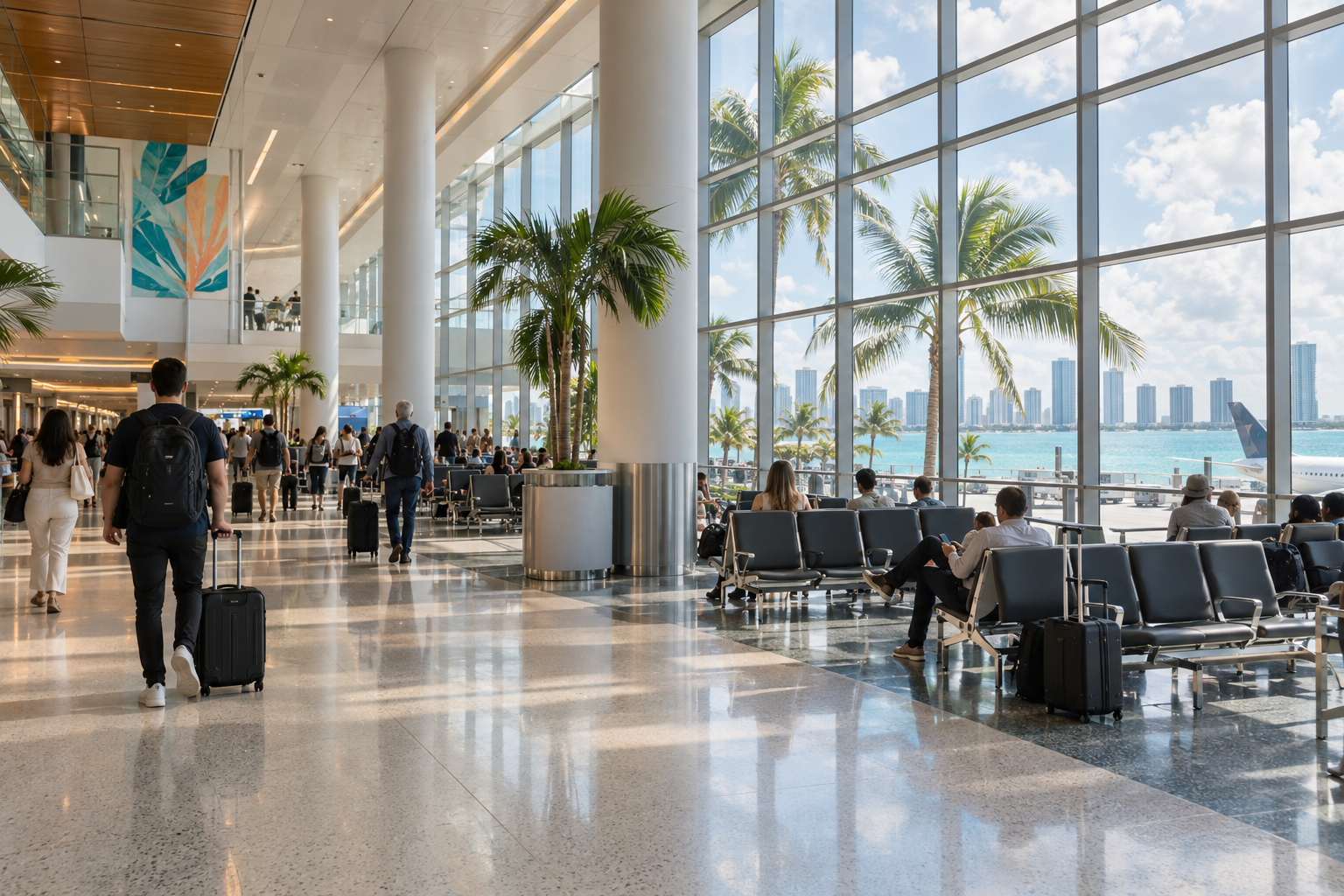
Miami airport is one continuous building with six concourses lettered D through J (there is no I). The three terminal names tell you which end of the horseshoe you are in. Walking the full length from D to J takes 25 to 30 minutes, so your concourse letter matters more than your terminal name.
| Terminal | Concourses | Main airlines | Notes |
|---|---|---|---|
| North | D | American Airlines, American Eagle | Over a mile long, internal Skytrain with 4 stops |
| Central | E, F, G | American (some flights), United, Spirit, Frontier, Southwest and others | MIA Hotel sits above Concourse E |
| South | H, J | Delta, Air Canada, and most European, Latin American and Middle East carriers | Concourse J handles the largest international arrivals |
Airline gate assignments move around, so confirm yours on the airport’s airline directory or your airline app on the day. The list above reflects the long-standing pattern, not a gate-by-gate guarantee.
North Terminal (Concourse D)
Concourse D is American’s hub and handles the majority of the airport’s traffic. It stretches more than a mile, and gates are numbered D1 to D60. The Skytrain inside the concourse runs post-security with four stations, so check your gate number before deciding whether to walk or ride.
Security for D has multiple checkpoints along the departures level. The checkpoint at the far north end (near D1) is often quieter than the ones nearer the center of the building. American’s Admirals Club and Flagship Lounge are both in D, and the concourse holds the widest selection of food at the airport.
Central Terminal (Concourses E, F, G)
The Central Terminal is the oldest part of the airport and the busiest for domestic low-cost carriers. Spirit and Frontier operate heavily from Concourse G, and that concourse can feel cramped at 6 a.m. when their early banks depart together. Concourse E serves a mix of American and international flights and has its own federal inspection area.
The Miami International Airport Hotel sits inside the Central Terminal on the second level near Concourse E. It is the only hotel inside the building, runs around the clock, and sells day-use rooms for long layovers. Book directly through the hotel for current rates.
South Terminal (Concourses H and J)
The South Terminal is the newest and the quietest to move through. Delta uses Concourse H. Concourse J is where many long-haul international carriers depart, including Lufthansa, Iberia, Air France, Qatar Airways, Avianca, LATAM and Copa. British Airways departs from Concourse F and Turkish Airlines from Concourse H. J also has the airport’s most spacious gate areas and a dedicated federal inspection hall for arrivals.
If you connect from an international arrival in J to an American domestic flight in D, allow at least 2 hours. You clear immigration, collect and recheck bags, pass security again, and then walk or shuttle the full length of the building.
Flights and destinations
MIA handles more than 50 million passengers a year and is the busiest airport in the United States for international freight and the second busiest for international passengers. American operates its largest Latin America and Caribbean gateway here, which is why you can fly nonstop from Miami to dozens of cities across Central and South America and the Caribbean.
The airport’s website runs live arrivals and departures boards, including an “en route” view for inbound flights. FlightAware tracks KMIA by its ICAO code if you want the raw flight-tracking view. For gate changes, your airline’s app updates faster than the overhead screens.
Sample nonstop domestic and regional routes
| Destination | Airlines flying nonstop | Typical flight time |
|---|---|---|
| Boston (BOS) | American, Delta, JetBlue | 3 hr 15 min |
| Washington Reagan (DCA) | American | 2 hr 30 min |
| Philadelphia (PHL) | American, Frontier | 2 hr 45 min |
| Nashville (BNA) | American, Southwest | 2 hr 15 min |
| Houston (IAH) | American, United | 2 hr 30 min |
| Phoenix (PHX) | American | 5 hr |
| San Francisco (SFO) | American, United | 6 hr |
| Grand Cayman (GCM) | American, Cayman Airways | 1 hr 20 min |
| San Salvador (SAL) | American, Avianca | 2 hr 45 min |
Schedules shift by season, and some of these are seasonal or less than daily. Check the airline directly for the current timetable.
Security, arrivals and expedited programs
Every concourse has at least one TSA checkpoint on the departures level. TSA PreCheck lanes run at the main checkpoints, and CLEAR identity lanes operate at several of them. Check the CLEAR site for the current list before you count on one.
Standard lines are longest from 5 to 8 a.m. and again from 2 to 5 p.m. on weekdays, and all day on cruise weekends. The MyTSA app and the airport’s own site publish estimated wait times by checkpoint.
International arrivals
Arriving international passengers clear U.S. Customs and Border Protection in federal inspection halls at Concourses D, E and J. Global Entry kiosks and Mobile Passport Control are available, and MPC is free and worth setting up in the app before you land. After immigration you collect bags, pass customs, and exit to the arrivals level.
If you connect to another flight, drop checked bags at the airline’s recheck belt just past customs rather than hauling them back to the ticket counter. Then follow signs to the nearest checkpoint for your onward concourse.
Local tip
Arriving at J and heading to the Rental Car Center? Skip the terminal crowds, take the elevator to level 3 and walk the Flamingo Garage connector toward Central. It is a straight shot to the MIA Mover station.
Services inside the terminal
Information desks sit near baggage claim in each terminal, and the airport’s customer service line is listed on its official site. Multilingual staff in red “Ask Me” style vests work the checkpoints and the arrivals level during peak hours.
Lost and found. Items left in the terminal go to the airport’s Lost and Found office. File a claim through the form on the airport’s site rather than calling first; it logs your description and contacts you if there is a match. Items left on an aircraft belong to the airline, and items left at a checkpoint belong to TSA, so contact them directly.
Baggage claim. Carousels are on the lower arrivals level under each concourse. Delayed or damaged bags are the airline’s responsibility; find the airline’s baggage office next to its carousels before you leave the hall.
Pet relief and service animals. Post-security animal relief areas exist in each terminal, and outdoor relief areas sit on the arrivals level. Signs mark them, and the airport’s accessibility page lists the exact spots.
Accessibility. Wheelchair assistance comes from your airline, so request it at booking. The airport runs the Sunflower lanyard program for hidden disabilities and has a multi-sensory room for travelers who need a quiet space; ask at any information desk.
Shops and food. Café Versailles and La Carreta sell Cuban coffee, pastelitos and medianoches in several concourses, and a colada before a 7 a.m. flight is the correct Miami way to start. Concourse D has the deepest range of sit-down restaurants and national chains. Prices are airport prices, so a cafecito will cost double what it does on Calle Ocho.
Art. The airport’s Explore Art program places dozens of permanent works through the terminals. The best known is Harmonic Convergence, the colored-glass walkway between the MIA Mover station and the terminal that bathes the corridor in rainbow light. It is worth the detour even if you are not taking the train.
Wi-Fi and charging. Free Wi-Fi covers the whole building. Charging outlets are generous in D and J, and scarcer in the older E and F gate areas, so top up before you head there.
MIA Future Ready and ongoing construction
The airport is in the middle of a multi-year capital program branded MIA Future Ready that is renovating the Central Terminal, adding gates and expanding the concourses. Expect temporary walls, rerouted walkways and the occasional closed restroom, especially in E, F and G. The airport’s site publishes construction notices, and following the overhead signs rather than your memory of the layout will save you a wrong turn.
Best time to fly through MIA
The calmest hours are late morning on Tuesday and Wednesday. The worst are Saturday and Sunday from noon to 5 p.m., when cruise ships at the Port of Miami and Port Everglades turn over and every checkpoint and rideshare lane backs up.
Seasonally, the airport is busiest from the week before Christmas through Easter, with spring break in March as the peak inside that window. Summer is quieter for domestic traffic but humid thunderstorms roll in most afternoons from June through September, and they ground flights for 30 to 90 minutes at a time. Hurricane season runs June 1 to November 30; if a storm is forecast, airlines usually post travel waivers two or three days out.
Good to know
Afternoon storms, not hurricanes, cause most summer delays here. Book morning departures from June to September if your connection is tight.
Nearby and connections to the rest of South Florida
Port of Miami. The cruise terminals are about 8 miles east, roughly 20 minutes by road outside of rush hour. Cruise lines run paid shuttles, and taxis use the county flat fare. On embarkation days, give yourself 45 minutes for the trip.
Port Everglades. The Fort Lauderdale cruise port is about 30 miles north. A taxi or rideshare takes 40 to 60 minutes. Tri-Rail plus a shuttle is possible but slow with luggage.
Fort Lauderdale-Hollywood International (FLL). The second airport serving the region is about 27 miles north and often cheaper for domestic flights on JetBlue, Spirit and Southwest. Comparing both airports before booking is standard practice among locals. Palm Beach International (PBI) sits about 70 miles north and serves the Palm Beach County end of the region.
Shopping. Dolphin Mall is about 5 miles west along the Dolphin Expressway, roughly 10 to 15 minutes by car, and it is the easiest place to kill a long layover if you have a rental car. Aventura Mall is a 30-plus-minute drive north and only makes sense with a gap of five hours or more.
Beaches. The closest sand is on Miami Beach, 30 to 45 minutes by taxi or on the 150 Airport Flyer bus. Our guide to miami beaches ranks the options if you are deciding where to spend a free afternoon.
Hotels. Besides the in-terminal MIA Hotel, dozens of hotels along NW 36th Street, Le Jeune Road and the Blue Lagoon area run free airport shuttles. Confirm the shuttle hours with the hotel because many stop running after midnight.
When to get help
For flight changes, cancellations and lost baggage, your airline is the only party that can act, so use its app or customer service desk at the gate or baggage office. For terminal questions, parking disputes or lost items in public areas, the airport’s information desks and the customer service number on its official site are the right route. For taxi fare complaints, note the cab number and report it to Miami-Dade County’s for-hire transportation office.
FAQ
What is the airport code for Miami International Airport?
The IATA code is MIA and the ICAO code is KMIA. Searches for “Miami airport MIA” or “Miami MIA” all refer to the same airport on NW 42nd Avenue.
How many airports does Miami have?
Miami-Dade County has one major commercial airport, MIA. The region as a whole has three: MIA, Fort Lauderdale-Hollywood (FLL) about 27 miles north, and Palm Beach International (PBI) about 70 miles north.
How early should I arrive at Miami International Airport?
Two hours before a domestic flight and three hours before an international flight is the standard advice, and it holds here. Add 30 minutes on cruise weekends and holiday weeks, and more if you are checking bags on a low-cost carrier at Concourse G.
Is there a train from Miami airport to downtown?
Yes. Take the free MIA Mover from the Central Terminal to Miami Airport Station, then board the Metrorail Orange Line to Government Center. The trip takes about 15 minutes and the standard fare is $2.25; confirm current fares with Miami-Dade Transit.
Where do I pick up a rental car at MIA?
All rental companies operate from the consolidated Rental Car Center at the Miami Intermodal Center. Ride the free MIA Mover from the terminal; it takes about 5 minutes.
How far is Miami International Airport from the cruise port?
The Port of Miami is about 8 miles east, roughly 20 minutes by car. Port Everglades in Fort Lauderdale is about 30 miles and 40 to 60 minutes.
Can I sleep at Miami airport?
The Miami International Airport Hotel sits inside the Central Terminal near Concourse E and sells overnight and day-use rooms. The terminal itself stays open overnight, though the airside gate areas close between the last and first flights and seating in the pre-security areas is limited.
Where can I confirm current parking rates and hours?
The parking page on the airport’s official website lists current hourly and daily rates for the Dolphin and Flamingo garages, valet and the Economy Park & Ride lot. Rates do change, so check there rather than relying on third-party sites.